
67th THESSALONIKI INTERNATIONAL FILM FESTIVAL
5 NOVEMBER → 15 NOVEMBER 2026

09.11.2026
NEWS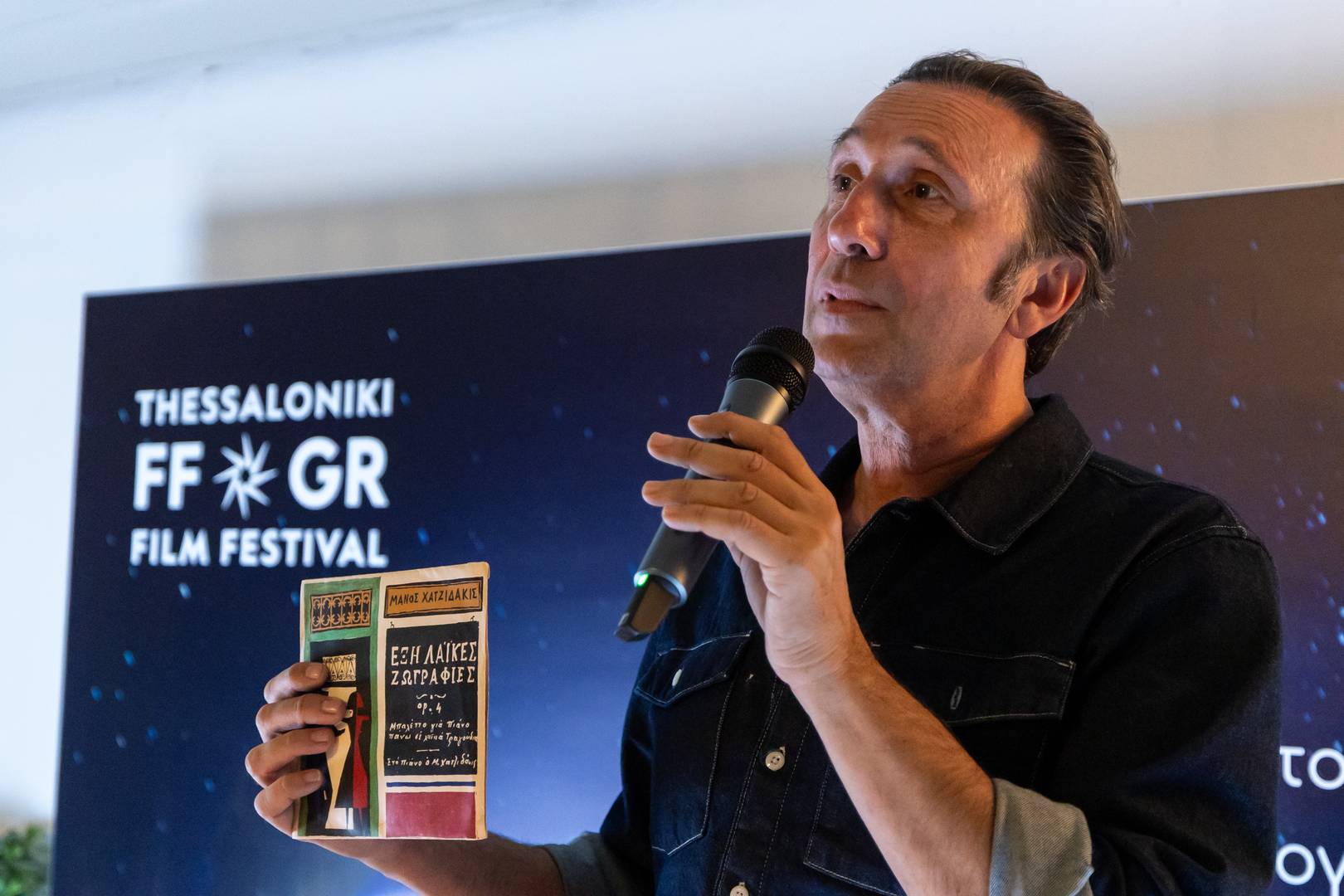
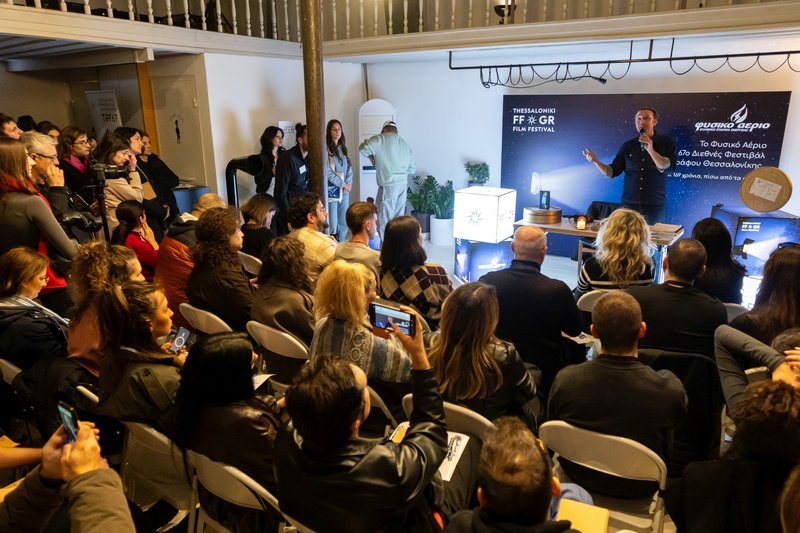
The value of the analog world, the power of memory and the importance of human imperfection in times governed by digital technology were at the core of the masterclass titled “Renos Haralambidis: The Analog World Strikes Back”, held on Sunday November 8th, at Ypsilon, within the framework of the 67th Thessaloniki International Film Festival.
The famous Greek director and actor invited the audience to a journey into his personal and filmmaking course, presenting objects, photos and memorabilia linked with defining moments in his life and his career as an artist.
The event was prefaced by the Festival’s Artistic Director Orestis Andreadakis, who made mention to the return of the analog world and the need for us to redefine our relation with time and image. “Is it a trend? Is it an obsession over nostalgia? I have an answer to that, which is negative: definitely not. It is a need, a need of the history of art to return to the very essence of things,” he noted. As he explained, it is the quest of a different rhythm, “a slower, more important rhythm,” which transcends the logic of fast content consuming on social media. “Things need to take on a different rhythm, they need to take their own time,” he underscored. Right up next, he welcomed Renos Haralambidis, pointing out that this masterclass is a chance for the audience to discover “this magical world of analog cinema and analog life,” while thanking Fysio Aerio - Hellenic Energy Company for supporting the event.
The floor was then given to Christina Voukia, Brand, Media and Trade Marketing Manager of Fysiko Aerio, who thanked the Festival, Orestis Andreadakis and all the partners who contributed to the carrying out of the event. In her brief greeting, she expressed her joy over this collaboration and welcomed the audience, wishing everyone to enjoy the event.
Taking the baton, Renos Haralambidis raised the key question right from the start: “What is it that makes us return to analog objects? What is it that brings us back to the analog world?”. Describing the analog world as a universe that can be touched and felt, he made clear that his approach does not constitute in any way a denial of technological evolution. “Digital revolution, we welcome you! Counterattack of the analog world, we salute you! We won’t go head to head with the here-and-now,” he mentioned, summing up this creative philosophy under the phrase: “I film in digital, I prepare in analog.”
He went on to talk about all people’s need to sustain a “personal museum”, a body of objects that serve as carriers of memories and feelings. Bringing into play Hop-o’-My-Thumb, Shakespeare’s The Tempest and Indiana Jones, he developed three different approaches on the importance of the analog world. As Hop-o’-My-Thumb left marks to find his way back home, people need personal buoys that connect them with their past.
On his part, one such personal buoy is a record by Manos Hadjidakis that he safekeeps ever since his childhood years. “I hold music into my hands. It is here. The music is not in a place far away,” he commented, explaining how the physical presence of an object can trigger memories and feelings that go beyond its practical utility. Making a reference to Shakespeare’s The Tempest and its legendary quote on the “stuff that dreams are made of”, he showed the audience a film print of his movie Cheap Smokes, stressing the importance of the tangible status of the cinematic image. “Man is body, not just poetry and ideas,” he pointed out.
Subsequently, he focused on the notion of time, drawing inspiration from a scene of an Indiana Jones film, where an old coin gains value thanks to the passing of time. On the basis of this example, he emphasized that all analog objects carry within them the traces of their stories, acquiring a singular sentimental and symbolic gravitas. Lying down the prep work in making a film and trying to demonstrate how analog experience is integrated in his life, he revealed keeping a stone from the Thermopyles historical ground in his place, holding it in his hands every time he needs to restore faith in himself. This particular object, tied to historical memory and determination in his mind, is part of a personal creative ritual.
His most recent film The Classic Masterpiece, an existential comedy where the analog and digital world meet, alluding to his debut film No Budget Story, held a special place at the masterclass. The director showed his old film camera, bought in 1992 from an open flea market in the neighborhood of Zografou in Athens, and reappearing in his latest film. Along with it an old film also resurfaced, which he had initially dismissed due to technical flaws. However, three decades later, the alterations caused by time graced it with an unexpected aesthetic value. As he explained, physical degradation created colors that no professional of digital coloring could ever reproduce in that way. “Therefore, it is still alive, by my side,” he commented.
The next stop in this journey through his personal archive was a Polaroid photo back from his days of youth, which he closely associates with the beginning of his course as a filmmaker. Through this photo he talked about the enthusiasm, the ignorance and the self-confidence that goes hand in hand with youthfulness, wondering how an artist can maintain these traits while growing up and gaining more experience. He also put on display a hand-written letter he received from Costa Gavras, highlighting the sentimental value a personal keepsake can acquire through the passing of time.
Moving on to talk about the creative process, he read excerpts from a small book of personal notes he had written back in 2013, bearing the title “Handbook of Cinematic Disobedience”, where he had gathered thoughts on cinema and the prep work for his films. He compared the groundwork of a film shooting with a highly demanding campaign, explaining that the real work precedes the moment a film starts to obtain its own life. “I build to be able to tear down and rebuild, as instructed by the adventures of filmmaking,” he mentioned, underscoring the need for coexistence between orderliness and unpredictability.
Towards the end of his main presentation, Renos Haralambidis went back to the importance he attributes to handwritten creative work, showcasing pages from old scripts crammed with corrections and notes. “In order for us to make better films, we need a better understanding of ourselves,” he said, analyzing how handwritten notes illustrate not only the thoughts, but the anxiety, the tension and the mental status of the artist caught in the process of writing. Moreover, he decoupled shooting on film and the experience of an analog screening, expressing his appreciation for the screening of 35mm films. The physical lines, signs and scratches on traditional film stock are nothing less than traces of the people who watched it and of the time that passed by.
During the talk that ensued, the audience was given the opportunity to pose a series of questions to the director, starting from how it is possible to feel nostalgia for a time we have not lived in. Renos Haralambidis replied that the experience of analog cinema is attached to a whole different meaning when compared to today’s digital reality. “For you to have lived the experience of the film, the film needs to be out of the picture. When we used to watch analog films in cinema, we were not living an experience, as that was cinema, end of story. We did not live the experience of the film, as there was no other experience available,” he explained. Referring to the feeling of nostalgia, he made clear that meaningfully experiencing the present time is the issue at stake, rather than returning to the past. “We do not wish to go back in time. We wish to be present in the here-and-now,” he underlined.
The discussion then shifted to the value of mistake and human imperfection, with the director sharing personal stories from his youth days. Making mention of his handwriting and spelling errors, he stated that even the flaws and weaknesses of a person can constitute an integral part of one’s personal identity. “My spelling errors are, too, a part of my signature. The errors of the digital world are artificial and staged, the ones of the analog world are genuine and real,” he stressed. He then recalled a love letter he was given in his childhood years, full of spelling errors, which, as he confessed, rendered it unique and invaluable in his eyes.”
Replying to a question regarding an old photo he showed earlier on, the director revealed that a snapshot from a photo booth, which he had initially dismissed because of a spontaneous funny face, thirty years later ended up becoming a source of inspiration for the film The Classic Masterpiece. As he explained, this personal analog archive served as a creative reservoir, allowing him to go back to images and memories furnished with new meaning in the course of time. “If it weren’t for my archive, my personal Renos Haralambidis museum, this film would have never existed,” he shared, highlighting the importance of personal keepsakes.
As to whether younger generations, having grown up in an inherently digital environment, are able to discover the value of the analog world, Renos Haralambidis emphasized the importance of handwritten creative expression as a means of self-awareness. “Handwriting brings you closer to your inner core. Our handwriting, which is never disclosed amidst the digital world, is our deep engraving,” he pointed out, separating the notion of character from that of personality. “Our personality can be seen even on an internet page. My character, however, will come across in my handwriting,” he explained. Moreover, he underscored that handwritten recording of thoughts can function as an inner quest process, allowing younger people to comprehend themselves more deeply. “When I am faced with a problem, I return home, I sit down and write, putting things into an order. Sitting and writing on my computer does not sort out anything for me,” he shared.
Elaborating on his thoughts, he accentuated the importance of material keepsakes, citing as an example the traditional paper tickets of cinema screenings, noting that an old ticket can keep the memory of a first screening or a personal acquaintance alive, obtaining sentimental value in the course of time. “Our personal stories need testimonies, a materiality that proves “we lived it, we were there,” he stressed, while adding that objects of the analog world can be acknowledged as tangible evidence of our personal story in life.
The discussion concluded with Renos Haralambidis urging the audience to return to simple analog habits, such as writing letters or sending postcards. He also referred to the importance of photo printing and the unique charm of old film developing techniques, while also sharing some more stories from his filmmaking career. Calling it a wrap, he made one more reference to Shakespeare and The Tempest, reminding the constant rapport between the past, memory and the creative process.


