What's on

CINEMATHEQUE

A Dog’s Dream

Angelos Frantzis

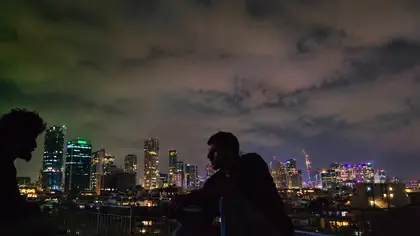
The film tells the story of a magical night in Athens. A man has a dream about a strange robbery. When he returns home, he finds that all his belongings have been stolen in an equally strange manner. The man calls the police and an experienced cop tries to solve the case with rather unorthodox methods. But as the night drags on, the mystery gradually appears to spread throughout the city. Strange incidents lead the film’s heroes on a journey that appears to escape reality and meet the world of the dream

CINEMATHEQUE

Attenberg

Athina Rachel Tsangari

Marina has grown up with her architect father in a small industrial community, almost cut off from the reality of the rest of the world. With the exception of her bizarre friendship with Bella and the companionship she shares with her ill father, Marina observes human behaviors from afar, almost with repugnance. Her guides in this world of humans are Sir David Attenborough’s documentaries on mammals, the music of Suicide and the awkward sexual awakening lessons she receives from Bella. Until a young mechanic arrives in town. On this strange and simultaneously ideal canvas, namely an environment from which “normal” life is absent, Attenberg plays with a fresh – and deceptively detached – formalism, only to develop into a moving study of characters and relationships.

CINEMATHEQUE

Avant-Drag!

Fil Ieropoulos

Avant-Drag! offers an exhilarating look at ten drag performers in Athens who deconstruct gender, nationalism, belonging, identity, while facing police brutality, transphobia and racism.

CINEMATHEQUE

Betty

Dimitris Stavrakas

This emblematic hybrid short, part fiction, part documentary, depicts 24 hours in the life of a trans woman, based on the autobiography of Betty Vakalidou. Memories of her former life intertwine with moments from the present as childhood collides with the struggles of adulthood and day gives way to night. Made just a few years after the fall of the military dictatorship and almost 40 years before gender transition was legally recognized in Greece, Dimitris Stavrakas' film paints a portrait of its heroine, while at the same time capturing a specific moment in history and a society in transition. Although rejected by the Thessaloniki Film Festival at the time, the film was released theatrically the following year, opening for Fellini's “Orchestra Rehearsal”.

CINEMATHEQUE

Bouzouki

Basil Maros

The story of Greek urban folk music (laiko) - and of modern Greece itself - told through the history of the bouzouki. Bayiaderas, Tsitsanis, Vamvakaris, Daskalakis, Roza Eskenazi, Eftychia Papagiannopoulou, Vicky Moscholiou, Marinella, Theodorakis, Hadjidakis, all feature in this rich musical journey. Rejected twice by the Thessaloniki Film Festival (first by the Censorship Committee in 1973 and then by the Preselection Committee in 1974) the film explores the sound that guided generations of great artists, marked defining moments in the country's history, and became a mirror of its time.

CINEMATHEQUE

Crying?

Alexander Voulgaris

Vasilis is an accountant at a film production company, where he is casting actors for a movie. Nadia is involved in the arts and is looking for a job. He has yet to mature, while she is shy and tends to underestimate her own attractiveness. When they meet, they discover their other half. The people around them often cry, for various reasons. A jigsaw of characters unfolds at the heart of a city. A breath before the Athens Olympics, the digital camera liberates vision and movement, as the screen fills with youthful spontaneity and a new urban romanticism.

Digger

Alejandro G. Iñárritu

CINEMATHEQUE

In the Sky of Nothingness with the Least

Christos Adrianopoulos

There were moments when I closed the door and my mind was flooded with questions. One of them was strong enough to turn on the camera. Do they love each other? Nota and Ilias are an elderly couple living in different worlds. The only common thing in these worlds is the slow and difficult decaying of the mind and body.

CINEMATHEQUE

Kalymnos, the island of sponge-fishers

Basil Maros

“The annual balance sheet amounts to 25 million dollars, five deaths, and three paralyzed men.” The hardships, dangers and joys of a small Dodecanese island whose livelihood depends on sponge fishing. Every dive carries the risk of decompression sickness, every voyage is a battle against the sea, while on shore wives, parents and widows are left waiting. The ritual-like preparation of a diver before his descent. The daily lives of the women and the festive homecoming of the returning sponge divers. Their lives during the months they spend on the island, alongside the entire process of preparing and marketing the sponges. The great celebration held before the sponge divers depart once again for another six to seven months at sea. An award-winning documentary about the hardships of everyday life, human suffering, and the joy that inevitably accompanies it in the cycle of life.

CINEMATHEQUE

Kastoria

Takis Kanellopoulos

“And as evening fell, a revelation unfolded within him. He slowly realized that what he was seeking, what he was looking for, the beauty he was searching for, the fairy was the city itself. Kastoria!” The third part of the informal “excursion” to Macedonia – that began with Macedonian Wedding (1960) and continued with Thasos (1961) – Kastoria, with its foreign traveler on horseback seeking a fairy in the modern but rather timeless everyday life of the Macedonian city, closes a perfect cycle of uncompromising documentation right as the curtain rings down on the 1960s. Takis Kanellopoulos has now definitively exchanged history for myth (and its representation), and here he uses it as a bridge between past and present, finally mythologizing a city which, through his gaze, regains anew the characteristics of a rare Greekness, carved from Byzantine ghosts, ancient Greek outbursts, materials of soil and water that are stateless yet deeply rooted in a Greece that remains to be discovered. The film, produced by Giorgos Nasioutzik and awarded Best Short Documentary Film at the 1969 Thessaloniki Film Festival, was the least proprietary of its creator’s works and hard to find – even lost – over the years. It reappeared after a long absence in 2025, not in its original color version, through a network of collectors, providing the opportunity for a comprehensive study on Takis Kanellopoulos’s trilogy, a turning-point for creative documentary in Greece.

CINEMATHEQUE

Macedonian Wedding

Takis Kanellopoulos

“For unto us a director is born” raved the Greek press after Macedonian Wedding first screened in 1960. And rightly so, for this short documentary that anointed the 27-year-old Takis Kanellopoulos as Greek cinema’s new hope overnight is a visual poem of rare sensitivity. What starts as a documentation of joyous wedding rites in an eastern Macedonian village (Velventos in Kozani) is transmuted through the director’s gaze into an elegy on the parting of ways – as if Persephone is to descend into Hades – and the chthonic, paganistic bite of the natural world. The germ of Kanellopoulos’ later work is already apparent here: the low-key tone, the lyricism, the Macedonian landscape, the charge borne by what is borderline, and the female face that so captivated him. Macedonian Wedding won Best Short Film at the First Week of Greek Cinema, and First Prize at the Belgrade Film Festival (1961).

Naza

Yuval Abraham, Rachel Szor

Silent Friend

Ildikó Enyedi

In Silent Friend, Ildikó Enyedi weaves a story that unfolds over three different time periods, centered around a towering Ginkgo tree, located in the botanical garden of a German town, which becomes both a symbol of eternity and a silent observer of human history. In 1908, Grete is fighting for admission to the Botany School of a German University only to be faced with the insurmountable limitations imposed on her gender. In 1972, Gundula studies what plants sense, with the assistance of her anti-social classmate, in a field where science intertwines with unspoken desire. In 2020, neuroscientist Tony Wong and renowned botanist Alice Sauvage seek the unseen connections between nature and man – and perhaps, between themselves. Imbued with aesthetic excellence and the emotional sensitivity inherent in her works, Enyedi constructs a nuanced film of subtle beauty that captures the eternal and the ephemeral like the rustling of leaves. Like fleeting moments in human lives, we seem condemned to live only a small leaf of this tree which represents time, or humanity itself, our very own world.

CINEMATHEQUE

Stray bodies

Elina Psykou

Robin is pregnant but does not want to become a mother. Katerina wants to have a child but cannot. Kiki simply wants to die with dignity. Yet abortion, in vitro fertilization and euthanasia, respectively, are illegal in their home countries. “Stray Bodies” explores bodily autonomy in a Europe where people are free to travel, work, and consume, but not always free to live, or die, as they choose. A “head on” documentary about a freedom that is widely proclaimed but selectively upheld.

CINEMATHEQUE

Thasos

Takis Kanellopoulos

“In making this short film about Thasos, we were not seeking to depict the island. We were trying to capture something of its magic and its soul.” Staying true to the ethnographic approach he had just introduced with Macedonian Wedding, Takis Kanellopoulos would, with his second short film, continue to chart that unknown Macedonian region where folkloric kitschness co-exists with its critique, nativeness with its negation, and myths with their mode of narration. In Thasos, by the humble means of a limpid and poetic observational gaze, slivers of an island life routine are made into a proposal countering the picture-postcard image of an entire country, at precisely the time when Greece was experiencing its first explosive wave of tourism back in the 1960s. Rhythmic, at times frenzied and bordering on paganistic, structured around traditional folk songs of the Greek islands, with an emphasis on seeking out a sense of familiarity with the “feel” of the island, and with humankind and the natural world set at its heart, Thasos did not screen at the Thessaloniki International Film Festival. It did, however, receive a special mention at the Moscow International Film Festival, and was presented in anthology form at special screenings in Thessaloniki and commercial screenings in Athens, in time earning itself a prominent place within Kanellopoulos’ efforts towards a modernist approach that were renegotiating – at high risk, and with unprecedented decisiveness – the notion of patridognosía [locally-rooted knowledge of one’s homeland].

CINEMATHEQUE

The cosmic dissecting room show

Vasilis Vafeas

A multi-talented artist, Grigoris Semitekolo, seeking to escape the noise of the modern world and rediscover the innocence of childhood, retreats to the remote border island of Samos. There, a young woman guides him around the island and introduces him to the people of the port of Karlovasi, where he prepares a brief happening. As the locals gather to witness the performance, the creative process comes full circle: from the spark of inspiration to personal expression, and ultimately to communication with an audience. Using this premise, Vasilis Vafeas interweaves images of reality with those of his own imagination to trace the artist’s inner journey, from mourning to rebirth, from solitude to collective action and social engagement.

CINEMATHEQUE

The gleaners & I

Agnès Varda

Across France, Agnès met gleaners, scavengers, collectors, and finders. Through necessity, chance, or choice, they are in contact with what others leave behind. Their world is surprising. It is far removed from that of the gleaning women of the past who gathered ears of wheat left in the fields after the harvest. Potatoes, apples, and other discarded food, objects without owners and clocks without hands, these are the gleanings of our time. But Agnès herself is also the gleaner of the original title (“Les glaneurs et la glaneuse”) and her documentary is a subjective one.

CINEMATHEQUE

The man with the carnation

The Civil War is over, and one of the many left-wing resistance fighters forced into exile, Nikos Beloyannis, the man with the disarming smile and the carnation, a former captain in ELAS, returns to his homeland. Using the code name "Kostas", he goes into hiding at the home of a fellow comrade and establishes contact with Nikos Ploumpidis, along with other members of the underground Communist Party. The Plastiras government, seeking to consolidate peace and support the country's reconstruction, adopts a relatively lenient stance toward the communists. The military and the intelligence services, however, determined to undermine the government, fabricate a "communist conspiracy" and give extensive publicity to the arrest of Beloyannis, his partner Elli Ioannidou, and several other members of the Communist Party of Greece (KKE). During its original release in the 1980-81 season, the film sold 618,533 tickets in its first theatrical run and it was the best-selling film of the year.

CINEMATHEQUE

The Trouble with Being Born

Sandra Wollner

Elli is an android in the body of a little girl, living with a man she calls “father,” whose memories she has been programmed to share. One idle summer night, she sets off to the woods, summoned by a fading echo. A cinematic reverie that submerses us into a world of riddles and voids, challenging the absolute authority of memory. Deprived of this identity-defining mechanism, human existence can only succumb to the chaos of meaninglessness.

SPONSORS

COSMOTE
Alphabank
Fischer
Aegean

Be the first to get the festival news. Subscribe to our newsletter →

Χρηματοδότηση - ΕΣΠΑ Greece 2.0 NextGeneration English Full-resESPA 2021 2027 banner english banner hi-res