
67th THESSALONIKI INTERNATIONAL FILM FESTIVAL
5 NOVEMBER → 15 NOVEMBER 2026

10.11.2026
NEWS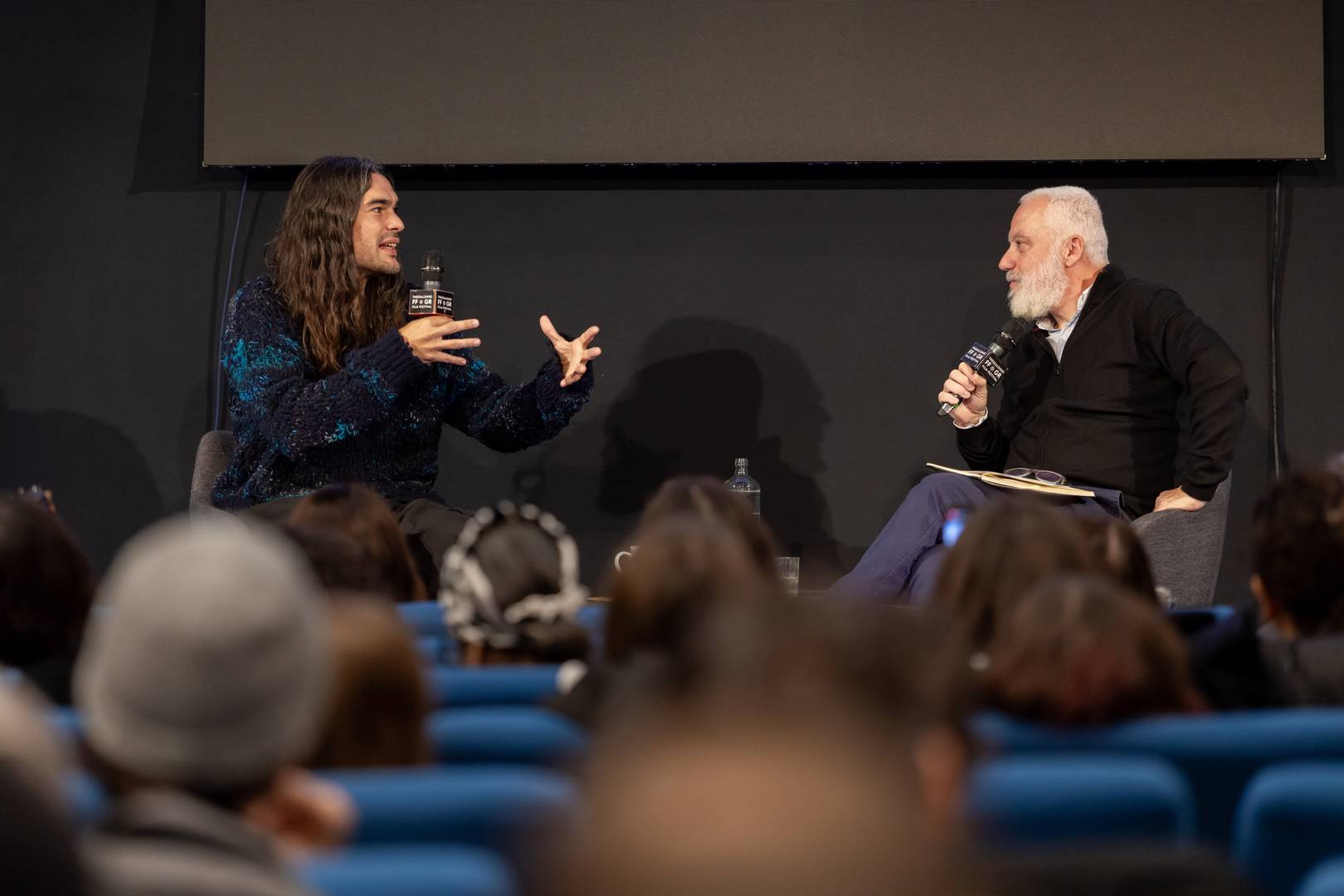
The multi-awarded Galician director and screenwriter Oliver Laxe met the Festival’s audience in an open talk held on Monday November 9th, at the theater Pavlos Zannas, within the framework of the 67th Thessaloniki International Film Festival’s grand tribute “Welcome to the Desert”. The discussion with Oliver Laxe was moderated by the Festival’s Head of Programming Yorgos Krassakopoulos.
“It is a great honor for us having you here, as we follow your career closely ever since your first steps,” said Yorgos Krassakopoulos, reminding the audience of the director’s previous films that had been screened at the Festival, You All Are Captains and Mimosas. Right up next, he underscored the particular importance of Oliver Laxe’s presence in this year’s edition, as the renowned director took on the role of guest curator in the Festival’s grand tribute, having contributed to the selection of its desert-themed films.
The starting point of the talk that ensued was the power of intuition, the place where the experience and the image exceed any explanation and norm respectively. The talk also revolved around the way his films are born out of landscapes, people, sounds and encounters, also centering on how a clear sense of direction could leave room for the unpredictable. “I have the feeling that we, as directors, are the worst enemies of our own films,” he commented as he took the baton, visibly satisfied by the presence of so many film directors at the packed theater.
Referring to the way he approaches the creative procedure, he explained that the initial idea always springs out of an image shaped in his mind. “When we create, we connect, and we do so through images. There are many different types of directors. I create through images. I am drawn to textures, colors, faces, sounds. Sirāt is a film I ‘edited’ in my mind as I danced at a rave party,” he said.
“We live in a time where everything demands a crystal-clear explanation,” he went on to mention, noting that this way to perceive art can ultimately affect how we experience it. “I don’t know if it is the way the film industry is structured or our societies as a whole, but we often have the tendency to remove from the equation the fact that art first and foremost is about feelings and emotion. We wish to communicate ideas and share, but we seem to forget that this is not necessarily the role of cinema. There is a limbo space between light and shadow, an ambiguity closely associated with the way one eventually experiences cinema.”
The talk then shifted to his early steps, with Oliver Laxe pointing out that very often film directors remain clung to technique, dismissing their personal drives and incentives. “The budget of my debut film was no more than 20,000 euros, giving me the chance to experiment, to discover and learn from my mistakes. Art, at least to a great extent, has to do with mistakes and our ability to accept them and learn from them.” As he stressed, the higher the budget of a film gets, the more restraints a film director is forced to face. “When money is a source of pressure, you become more conservative, as everything needs to go as planned; you cannot take any risks,” he said, adding that he considers himself particularly lucky, as he had the freedom to discover his own language.
A special mention was made to the production stage, as he undertakes the producer’s role in his films. “There’s the conventional way to make movies, and then there’s my way of working. I kick off from an image stuck in my mind and I start wondering: How can I adjust the cinema tools at my disposal in order to portray it?,” citing as example an incident during the shooting of Sirāt, when he had to legally organize an otherwise illegal rave party. “Within this context, production becomes a part of the creative process.”
Prompted by the solid point made by Yorgos Krassakopoulos regarding the spiritual aspect of his films, the talk soon turned to the relation between the metaphysics element and realism in Oliver Laxe’s body of work. “I don’t consider my films to be particularly spiritual, I guess they appear to be so when compared to most films of our times,” he humorously commented, before adding: “On my part, the transition is necessary, this need to break free from the barriers of the language. I wish to go beyond the domain of speech and reason. At the same time, I am attracted to reality; people, faces, landscapes. I guess I am interested in the point of convergence between these two dimensions.” Later on, he went on to add: “I make religious films, because when I watched Taskovsky at a young age, I experienced that transcendental feeling.”
Oliver Laxe spent a period of his life in Morocco, where he shot a great part of his early work. Replying to all those making a case for a westernized gaze upon the Arabic society, he commented that “we, as Western people, suffer from a great deal of guilt, often choosing to handle it by pointing the finger and blaming the others.” Making a mention of his own experiences and the way Arabic culture affected him, the film director highlighted the significance of empathy, as well as the need to reexamine how we observe and represent the “Other” in cinema.
“We are still amidst a de-colonization process. The best way to observe other people is by placing yourself in their position. You have to be willing to meet them, to forge a bond and accept how this encounter can transform you,” he said, while adding that all film directors should be ready to question their certainties. “History and culture in every part of the planet are interwoven,” he pointed out, alluding to the cultural affinities he discerned between the people of Morocco and his compatriots in Galicia. “In Morocco, I came to realize that we come in this world with the purpose to serve. This does not mean that I lack ambition. I have a strong sense of ego, and this is not by definition negative, as long as there’s a balance.”
Landscapes are at the core of Laxe’s film universe, as Yorgos Krassakopoulos remarked, serving not only as a backdrop, but taking center stage as a key narrative element. “I believe that nature possesses a transcendental quality, and that’s why it is soulful in my films. When surrounded by nature, you sense how meaningless you are in contrast with its infinitude. As a film director, I too succumb to arrogance. We believe we have the power to change the world, and every once and a while we could use a reminder that we are not in control of everything. Very often, while shooting, we get frustrated because things do not go as expected. Months later, we rewatch the material and we come to understand that it is beautiful exactly because it is gifted with a touch of the unexpected. Life has its own way to create images, and sometimes you just need to accept it,” stressed Oliver Laxe.
As for the desert, the main theme of the Festival’s tribute, and key pillar of his latest film, the acclaimed director commented: “The desert is like a mirror. There, you cannot escape yourself, you cannot hide. You are called to confront what you are really made of. In our everyday lives, we find ourselves in a state of constant distraction. In the desert you need to be alert, to be present, and that is one of its most enchanting elements in my view.” As he went on to express, this quest derives from his own inner need for connection. “I am searching for love. I, too, seek a way to cross the desert, I have wounds,” he confessed.
Throughout the entire talk, Oliver Laxe was disarmingly honest and open to self-criticism, admitting that even today his creative process goes hand in hand with insecurity. “Many times I am afraid to express what I truly have inside of me. Sometimes, I end up thinking: ‘You make a film that maybe no-one will watch, but you can count on becoming a better person through this process.’ And I take the leap,” he said, noting that you have to be willing to take risks in cinema. “I am a particularly fragile person, and my decision to become a director is to a great extent related with my need to protect myself. The crises we have suffered enable us to comprehend more deeply our inner world. Sirāt aspired to bring people faced up against death.” At that point, he made a mention of a ravers’ culture conviction, according to which all people who die while dancing make the transition to a transcendental dimension, pointing out that we are compelled to familiarize ourselves with the idea of the finite.
Last but not least, and with regard to Sirāt’s music, Oliver Laxe explained that he did not wish to use it as a form of “arm-twisting”, in order to elicit an emotional response from the audience, but as a “self-contained universe.” “We had been working on the film’s sound over a year prior to the beginning of the shooting side by side with the composer,” he mentioned, and concluded his talk with a particularly contemplative and personal thought: “To me, film directing is like a prayer. It is my way to celebrate life’s complexity, express my gratitude for being alive and feel connected with anything occurring around me.”


