
FFGR

Screening of the film I Is Another attended by lead actor Claes Bang and director Felix Randau
08.11.2026
NEWS
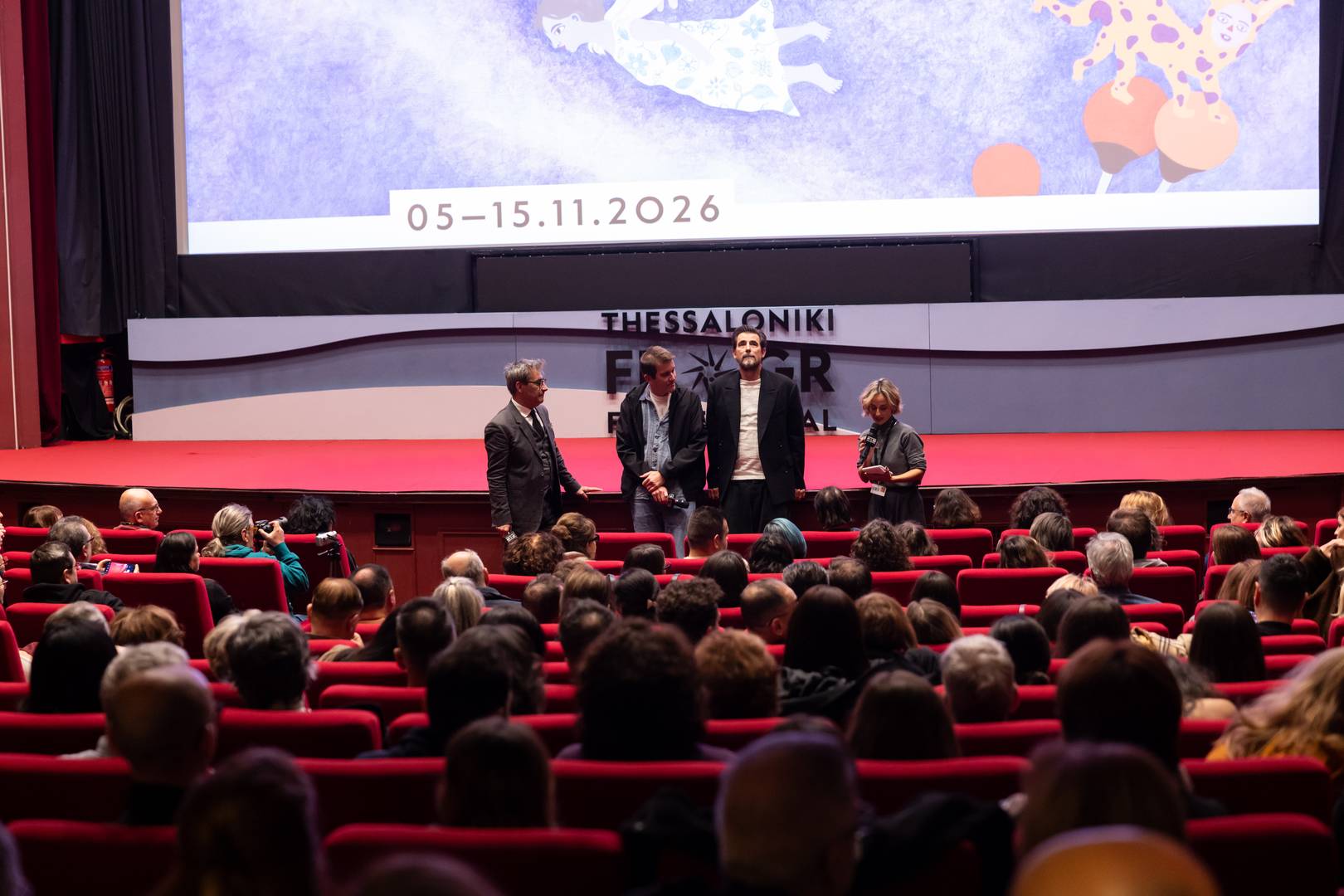
The screening of the film I Is Another was held on Saturday November 7th, at the packed Olympion theater, in the presence of the director Felix Randau and the Danish actor Claes Bang, within the framework of the 67th Thessaloniki International Film Festival.
The Festival’s Artistic Director, Orestis Andreadakis, welcomed the audience: “There are films that bring us face to face with the morality of history; the events that occurred and the ones that should have occurred. They speak to us about people who used war to their own advantage, trying to change the truth to their benefit. One such film is I Is Another,” he stressed, before calling the director and the protagonist on stage.
Director Felix Randau thanked the audience for attending the screening, as well as the Festival for the invitation and the chance to present his film. “I hope you will enjoy the powerful performances, and please keep an eye out for the little traps that unfold throughout the film’s story,” he mentioned.
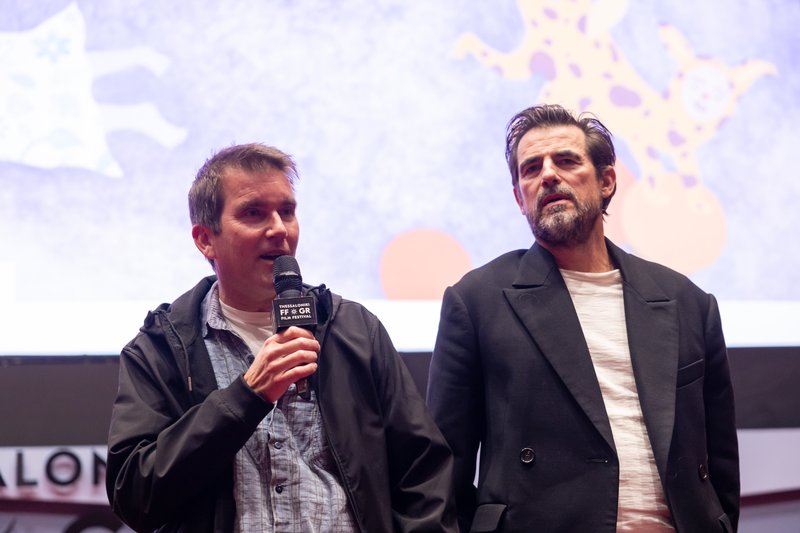
The talk that ensued focused on questions of morality and historical truth, placing particular emphasis on the dramaturgical development of the film, its plot twists and the inner contradictions of the two main characters. A special mention was also made of the notion of “truth” that runs through the film and is foregrounded as an up-to-the-minute and timeless issue.
“I highly appreciate films that can last in time. I did not wish to make a film limited to the representation of a past historical era. Instead, I was interested in exploring its connection to the present. A period film that does not engage in conversation with the present times would have no particular value for me. I wanted my film to touch upon contemporary concerns, one of which revolves around the inability to form a common ground as to what is considered and labeled as truth. Even though the story is set in the 1940s and the 1950s, the film brings to surface many issues that remain extremely topical and timely,” commented Felix Randau.
As for the instruments he put to use in order to approach the multifaceted and ambivalent character he portrayed, Claes Bang explained that his key point of reference is his own personal experience: “My key ‘instrument’ is none other than myself. In every role I try to embody elements from my own personality, making the most of everything that nests already inside of me. In this particular case, the finely crafted script played a defining role. I try to approach every role as if I and the character were the same person, integrating traits of my own personality.”
“As far as this specific character is concerned, one of his fundamental traits is his profound desire to leave a legacy for which he would be remembered. I believe that if he was just satisfied with everything he had accomplished, there would be no story for us to tell. What fuels him is his inner need to overstate his achievements and to make sure that his name will go down in history. And to be perfectly honest, I recognize something from my own character in all the above. In that sense, I did not need to seek any outside acting instrument, all I had to do was to put myself into force and look for my points of convergence with the character.”
With regard to the writing process, Felix Randau mentioned: “I just follow my instinct. There was no conscious attempt for a plot climax. I do not think in terms of structure, nor do I believe in a secret recipe one needs to follow while writing.” The director pointed out that the screening in Thessaloniki is the second unveiling of his film following its premiere at the Locarno Film Festival. As the film has not yet been screened in Germany, and given the fact that it deals with issues of historical memory and identity, he admitted anticipating with curiosity the reactions of the German audience.
From his standpoint, Claes Bang referred to the difficulties of carrying out such a project, underscoring the time needed to ensure the necessary state funding. “It took almost five years to secure funding from the German state. This was mainly due to the strict restrictions concerning the depiction of the Nazi regime. In the film, Himmler is not portrayed in the expected way. This differentiated approach clashed with the usual conventions that enable the obtaining of state funding,” he explained.
When it comes to the selection of the train as the main scenery of the film, inside of which the story unravels, the director revealed that it was a decision that came up during the 5-year pending period for the funding to be greenlit. “What I initially had in mind was to place the plot in a German countryside house. However, following such a long wait, there came a moment when I myself started to get bored of my own script. I knew I had to change something. Making a film is inextricably linked to the notion of resilience. It takes a great deal of patience. So, after a long period of simply waiting for things to start rolling, I decided to place the plot in the confined space of a train, and it worked out pretty well. The limited space the characters have at their disposal leaves no margin of escape,” remarked Felix Randau.
As to the current verdict on mankind, almost 80 years after the events portrayed in the film, Claes Bang centred, among others, on the incentives that trigger human actions, as well as on the contradictions that go hand in hand with the human ambition for excellence. “The very logic behind the act of granting awards is fundamentally defective. I have received many awards and I am really proud of them, and that alone entails a contradiction. It is interesting to explore the incentives behind people’s actions. The same process applies to the film’s main character: What did his actions aspire to? Recognition and posthumous legacy? Or did they spring from an honest and deepest desire to contribute? This question lies at the very core of the film: Vanity and the need for recognition. Just take a moment to think of a particular man on this planet nowadays who so passionately covets the Nobel Peace Prize, there’s no example more suited to prove how fallacious the whole award-giving process can become,” he commented.
As the event came to its conclusion, Felix Randau was asked whether the film runs the risk of humanizing Himmler in the eyes of the viewer, and his reply was firmly negative. “One of the most grave mistakes we commit nowadays is our effort to evaporate evil into thin air, hushing up its very existence. Yet, this obfuscation is what nurtures it and allows it to thrive. I believe that the best way to portray Himmler was to bring forth his human side. I never wished to create a monster-like character, in the borderline of the grotesque. In fact, remarks were indeed made in Germany suggesting that I give this character a voice. However, I had no intention of defending him. Quite the contrary actually,” the director made clear.



