
67th THESSALONIKI INTERNATIONAL FILM FESTIVAL
5 NOVEMBER → 15 NOVEMBER 2026
12.11.2026
NEWS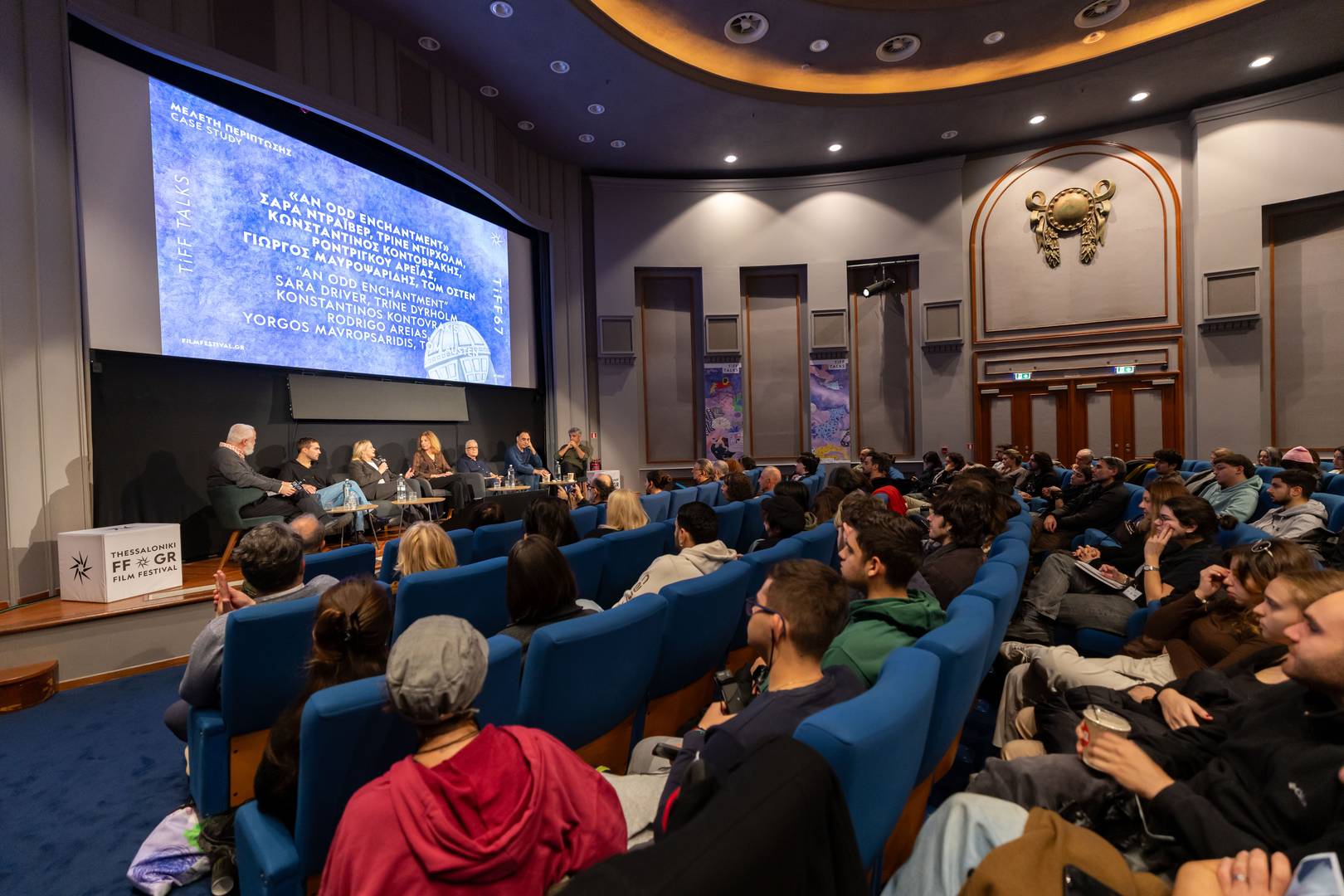
American filmmaker Sara Driver, Danish actress Trine Dyrholm, British actor Tom Austen, producers Rodrigo Areias from Portugal and Konstantinos Kontovrakis from Greece, as well as film editor Yorgos Mavropsaridis joined forces on Wednesday morning, November 11th, at Pavlos Zannas theater, within the framework of the 67th Thessaloniki International Film Festival, to take part in a talk revolving around the new film they are working on, titled An Odd Enchantment. The six creators’ acquaintance first emerged from the Thessaloniki International Film Festival.
This collaboration vividly illustrates how cultural events can serve as a meeting place for creators and a space for artistic cross-pollination. “We’re proud that the Festival played a part in bringing these people together,” remarked Yorgos Krassakopoulos, the Festival’s Head of Programming, who welcomed audience and speakers alike and moderated the discussion.
Sara Driver thanked the Festival for the invitation, pointing out that it was precisely this event that gave her the chance to get to know all five of her collaborators. “I met Konstantinos Kontovrakis during the 65th Thessaloniki International Film Festival in 2024, when I was a member of the International Competition Jury,” she mentioned, stating that one introduction led to another until a group was established that, to this day, still maintains close ties, both on a professional and a personal level.
The contributors’ meeting was the starting point in a discussion that swiftly moved onto broader matters regarding contemporary filmmaking, such as the importance of European funding and the safeguarding of creative freedom. Special emphasis was also placed on surrealism, through which the film approaches trauma and the way it’s processed. The audience had the opportunity to watch an excerpt from the film, which, as Konstantinos Kontovrakis divulged, is set to have its theatrical release in the winter of 2027.
“The film is an exploration of how we can deal with violence through imagination. The protagonist survives a mass shooting, and uses her imagination to cope with the terror she experienced,” the filmmaker explained. As she noted, her interest on the subject stemmed from the need to understand how survivors process trauma, amidst a particularly violent period, full of turmoil, for the US.
Sara Driver also referred to how profoundly the attack on the Twin Towers affected her, changing the way she perceived matters fundamentally. “I believed I wouldn’t be able to laugh again after everything,” she notably said, adding that, at the same time, her film is intricately intertwined with the beauty of life, the power of imagination, laughter, and friendship.
.
Trine Dyrholm reflected on the very first email she received from Sara Driver after their introduction in Thessaloniki, containing the moodboard for the film, and on the script that came shortly thereafter. “I’d never seen anything of that sort. There was something whimsical to the whole thing, something truly unique. Sara’s universe began inexplicably drawing me in, and thus, I decided to follow this feeling,” she noted.
Konstantinos Kontovrakis confessed that, both as a producer and as a viewer, he’s often skeptical when presented with surrealism. “When I read the script, I instantly realized this was a story about imagination and creativity, but also about all the forces that undermine them. I decided to risk it and invest in the film, since I discerned something truly intelligent in Sara’s story, along with a rare honesty,” he disclosed.
Rodrigo Areias shared his first impressions as well, stressing that at a time when cinematic narratives are frequently recycled, Sara Driver’s script stood out thanks to its imaginative quality. “Such a film is a hopeful sign,” he commented, before divulging a memory from their collaboration.
“During the prep, we were looking for a house for the shoot. We toured many until we decided on a medieval one, situated very close to my hometown in Portugal. This choice, of course, presented several practical difficulties. Half the house had no power, and we had to be very careful so as not to cause even the slightest damage. But Sara always made everything seem easy. There was always an upbeat mood, and each day ended on a jubilant note,” he recalled.
With the film entering its final stages, being just three weeks away from the completion of the editing, Yorgos Mavropsaridis offered his thoughts on some of the aesthetic and technical choices made. “The film unfolds like a magical universe. The sound, for example, plays a decisive role, seeing as the protagonist suffers from misophonia, so our main goal was to create a soundscape that conveys this trait. At the same time, we relied on analog methods, without CGI. The outcome is, in a way, handmade, crafted with love and care,” he remarked.
Tom Austen described his collaboration with Sara Driver as something that emerged in a very organic manner, recalling their first communication, as well as the anxiety he felt prior to his first video call with the filmmaker. “When you come upon a script like this one, the question isn’t whether you’ll accept to take part in it, but how you’ll make it happen. I remember Trine telling me of this magical universe and finding myself already wondering how I could be part of it. And while I was thinking on it, an email came asking for a meeting with Sara. It was one of those meetings, where the only thing on your mind is that you’ll make a mess of things out of sheer enthusiasm,” he said, laughing.
Trine Dyrholm added: “I like good people. I’ve got a feeling about them, and I believe this to be one of my most important assets. I try to follow this same intuitive approach in my work as well. Festivals –I’m incredibly grateful to be here by the way– give you the opportunity to get involved in creative discussions, inspire others and be inspired in return. As an actress, I’m called upon to respond to the audience’s need for entertainment, yet what primarily interests me is sharing, through cinema, the existential weight we all bear. When you encounter people with whom you share a common vision, you wish to be close to them.” Konstantinos Kontovrakis revealed that the team will come together again for Tom Austen’s debut feature film. The British actor will step behind the camera, taking on the role of both scriptwriter and director.
Sara Driver also focused on the organic way in which the group’s collaboration developed, emphasizing that the key objective in filmmaking is “finding solutions.” “Our production team has many years of experience in filmmaking, and a strong grasp on how things work in practice,” she highlighted. Konstantinos Kontovrakis went on to add that this particular collaboration is an interesting case study on how people from different countries and cultures can find a common creative language and build a smooth partnership.
Rodrigo Areias talked about funding, focusing on independent filmmaking in particular: “Countries change, yet we must continue to resist. We must constantly advocate for fair funding conditions for independent cinema. It is a reality we are forced to deal with continuously these last few years in Portugal.”
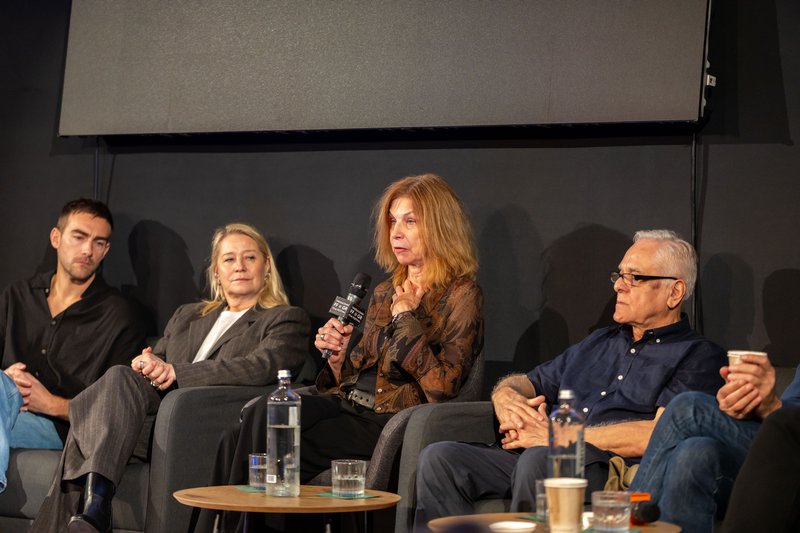
Replying to questions from the audience, Sara Driver spoke extensively about what led to her choosing surrealism as a narrative medium, as well as the creative process she followed: “We are often absorbed into our screens, and this is one of the beautiful things about festivals: they give us the opportunity to come together, exchange ideas and thoughts. Surrealism is a form of expression I love, so scriptwriting emerged quite spontaneously. We don’t see a lot of fantasy films being made these days. Yet, I believe that this genre can transport you anywhere,” she mentioned.
“I was raised in a country where violence permeates nearly every facet of daily life. I’ve been processing these thoughts for years, and perhaps my father’s death was what finally compelled me to give them shape. I distinctly remember a moment, shortly before he passed, when I showed him a painting. He starred at it and told me: ‘I’ve got wings, too.’ The film is an homage to my father, who was a gangster of the imagination,” the filmmaker added.
Yorgos Mavropsaridis added a different perspective to the film’s interpretation, pertaining to the element of violence, pointing out that “it explores its various manifestations, a characteristic example being the way in which the US has established their sovereignty in the filmmaking industry.”
Asked how younger audiences might receive a film with such intense surrealist elements, Rodrigo Areias expressed the opinion that the new generation is particularly accepting of different art forms, despite the fact that digital platforms’ algorithms limit the scope of their options. “It’s the producers’ and the creators’ responsibility to ensure that the younger generation will have the chance to come into contact with different art forms,” he stressed. Trine Dyrholm concluded the talk: “I’m incredibly proud that producers such as you exist – producers who believe in this genre of cinema, which often requires far more tenacity and patience than others.”


