
FFGR

TIFF TALKS: Rediscovering Andreas Velissaropoulos’s "Opera"
14.11.2026
NEWS
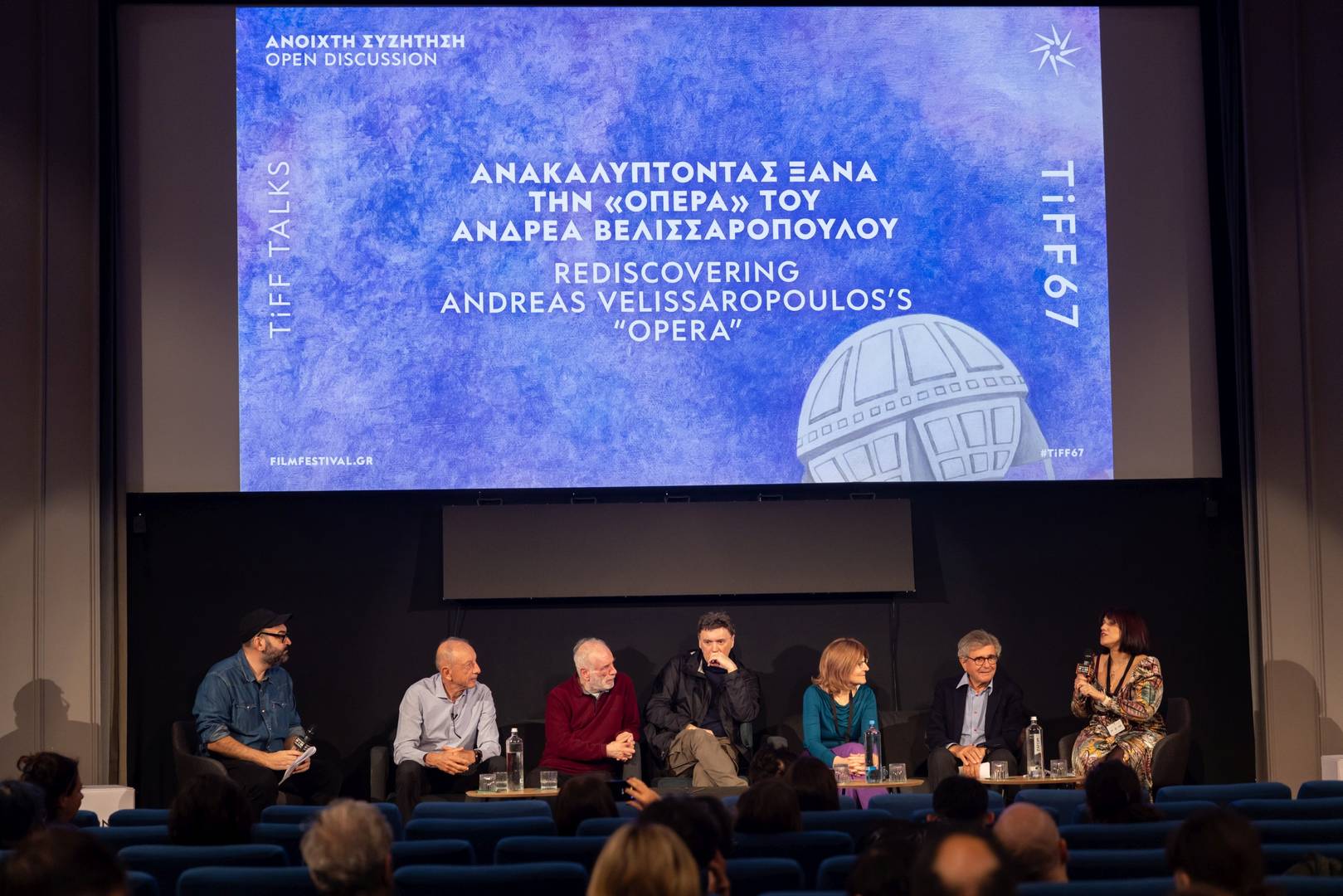
Collaborators, friends, and scholars of Andreas Velissaropoulos’s body of work met on Friday, November 13th, at Pavlos Zannas theater, within the framework of the 67th Thessaloniki International Film Festival’s TIFF Talks, to discuss Opera (1976), one of the most iconic lost films of Greek cinema.
The discussion, which followed the unveiling of rare footage from the shoot, featured director of photography Yannis Daskalothanasis, film director Takis Spetsiotis, film director Iris Zachmanidi, Konstantinos Kyriakos, Professor of Theater History and Greek Cinema, as well as the director’s brother, Pantelis Velissaropoulos. The talk was moderated by film critic Manolis Kranakis and the Festival’s Head of the Greek Program, Eleni Androutsopoulou, who were the ones responsible for curating the research, screening, and talk.
Opera had been screened for the very first time at the 17th Thessaloniki Film Festival in 1976, although its traces were lost during the 1990s. Since then, it has been considered “the holy grail of Greek queer cinema.” The speakers discussed the film’s place in Greek film history, as well as the filmmaker himself, who passed away in 1985, at the age of just 38.
The Festival’s Artistic Director, Orestis Andreadakis, welcomed the audience: “Today, the Thessaloniki International Film Festival is fulfilling a promise we made in 2018, when we organized the first tribute to Greek queer cinema and succeeded in showcasing every queer film but one, an iconic film lost to time.” He then gave the floor to Eleni Androutsopoulou and Manolis Kranakis, who, as he stressed, loved this story and sought it out relentlessly, which has resulted in the research making considerable headway at this point in time.
Eleni Androutsopoulou stated that the search for Opera emerged as a continuation of a broader effort to locate lost films: “When we organized the tribute to queer cinema in 2018, at the 59th Thessaloniki International Festival, we had attempted to find Opera, unsuccessfully. This stayed with us. A few years later, together with Manolis Kranakis and Yannis Palavos, we curated a tribute to Takis Kanellopoulos, and chanced upon the same issue: Kastoria was nowhere to be found. At the time, the tribute was held without Kastoria, however, a year later, the film was found. We organized a tribute to it, and the audience was able to enjoy it once more. This brought us immense joy, a sense of fulfillment, and a feeling of a small victory. Not that long ago, Andreas Velissaropoulos’s roommate and collector, Dimitris Xanthoulis, reached out to Manolis Kranakis. He told us he’d stumbled upon a box labeled ‘Opera,’ containing 8mm footage, and that he’d like for us to have it to examine it. As such, we decided this would be a great opportunity to gather colleagues, friends, and loved ones of Andreas Velissaropoulos here today, so as to explore his work and gain a greater understanding of the person behind the film through the evidence we have available at this time.” As Eleni Androutsopoulou explained, it wasn’t the film itself, but footage from the shoots. Thus, the search for Opera continues on.
Prior to the screening, Manolis Kranakis introduced the framework through which to view the material, providing the necessary guidelines so that the audience could better understand it: “It’s been 50 years since September 1976, when Opera was screened as part of the official program of the 17th Thessaloniki Film Festival. It was a film that was, theoretically, a cornerstone of Greek queer cinema, before such a thing could even exist. The material we’re about to watch is silent. The film is entitled Opera and it revolves around music, drawing from Richard Wagner’s Tristan und Isolde, a work Andreas Velissaropoulos himself thought of as the epitome of romanticism. Excerpts from the opera were featured in the film, along with other musical pieces.” Manolis Kranakis then added: “People who’d seen the film and tried to recall it have confirmed that the material you’re about to watch includes exact images from the original film. So, those of you who know the opera can imagine and piece together what cannot be heard. At the same time, those of you who are observant will be able to discern distinct trends of the era, as well as well-known figures of Athenian society, who subsequently played a pivotal role in literature, arts, and culture.”
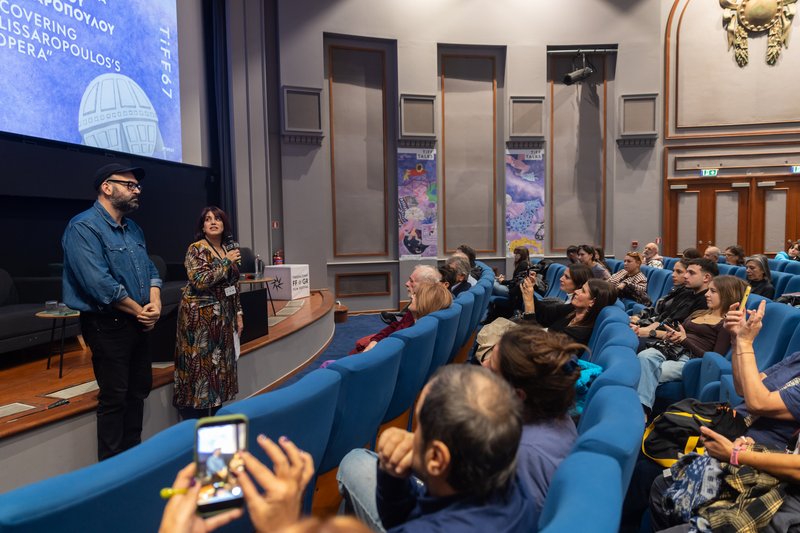
Thirty minutes of silent behind-the-scenes footage were then screened, and an open discussion ensued afterwards, which, as Manolis Kranakis pointed out, was structured around three main axes. The first centered on the film itself, which moved along the realm of cinematic experimentation, drawing a plethora of influences from the era’s European avant-garde scene. The second focused on the historical and social context at the time of its creation - shortly after the Metapolitefsi, when a young group of people began to open a discussion around issues of identity, sex, sexuality, and diversity. The third axis was Andreas Velissaropoulos himself, an iconic activist in Greece, as well as the founder of the Liberation Movement of Homosexuals of Greece, who, as noted by Manolis Kranakis, insisted with some kind of romantic idealism on signing off as a director until the end of his life, which unfortunately came too soon, as he was among the earliest victims of AIDS.
The discussion kicked off with the film’s director of photography, Yannis Daskalothanasis, who had even unearthed photographs from the filming. Those photographs were projected onto the screen during the discussion’s entire duration. Mr. Daskalothanasis explained that the footage shown was a Super 8 reel, shot by Andreas Velissaropoulos in parallel with the shoots, as well as a year earlier, when they were doing tests. “I hope that one day the film’s negative will be found,” he said on the lost film, which, as he mentioned, constituted his own admittance to the art of cinema: “In 1976, alongside my fellow students, Andreas, Iris Zachmanidi, Takis Spetsiotis, and many more, I was making my graduation film. So, there I was, a 22-year-old young man, suddenly finding myself at the Thessaloniki Film Festival, within the spotlight, which was a big deal to me. The film was screened one evening at a theater in the Society for Macedonian Studies. When the screening began, something entirely unanticipated occurred, something I didn’t expect to experience. There was such upheaval coming from the balcony that I panicked. This continued as we were leaving. I remember Andreas on the stairs, and people we didn’t know trying to attack us. But for me, this experience was incredibly important.”
Yannis Daskalothanasis also recounted some memories from his collaboration with Andreas Velissaropoulos: “Andreas encouraged me, with all the ideas he had, to create something that had more to do with expressionism rather than simple documentation, as was usually the case in a feature film. I had to follow a model that only painters employed. “That’s why I used theatrical spotlights, so that the scenes could be shot in a way that isolated the subject at the right moment, for as long as was necessary, and then let it be swallowed by the darkness.” He also referred to the exceptional work that had been done on the film’s color and costumes, curated by Antonis Exadaktylos.
Next, Manolis Kranakis cited the critical acclaim the film received during its screening at the Festival in 1976, before giving the floor to film director Takis Spetsiotis, who shared unknown stories - until that point in time - from his collaboration with Andreas Velissaropoulos: “I remember I went to the night shoots, held on the rooftop of his apartment, surrounded by unlit sets, and was impressed that he was always tinkering away or painting. Andreas looked up to the German experimental filmmaker, Werner Schroeter. His work had a dual character - bringing together music and painting, with a lot of references to the Renaissance and, primarily, to Leonor Fini, an Argentine-Italian painter, affiliated with the feminist movement, who was well-known for her works exploring gender identity.”
Takis Spetsiotis also referred to Andreas Velissaropoulos’s relationship with the island of Syros, while simultaneously recalling, with deep emotion, long forgotten memories brough forth by the lost film’s scenes. In a particularly charged moment, the director couldn’t hold back his tears: “I hope he’s well wherever he is, and that he’s receiving this positive energy from his friends – whether under a rock, beside a little lizard that never grew up to evolve into a dragon, on a flower’s stem, or lurking behind the US Embassy, where his home was once located. ‘We are left with what we’ve lost,’ according to a poet.”
Konstantinos Kyriakos, Professor of Theater History and Greek Cinema, touched upon the film’s pivotal role as the beginning of Greek queer cinema, emphasizing that Opera was the missing link in the 2018 tribute. “In 1976, in the early post-dictatorship years, there was a major dilemma: Greek identity, or international trends? Or perhaps an attempt to interpret Greek history, gender, and nation through the lens of European and American culture? Sometimes artists find something akin to a reborrowing. Schroeter, for example, had come into contact with the American underground. By the same logic, the novelty being introduced on an aesthetic level is a question that is creatively realized in Opera, a film crafted by tesserae, illustrative imagery, and details, which we interpret through the filmmaker’s own words. Velissaropoulos defended and explained the film’s aesthetic, so we have his guidance, which functions as a fundamental bridgehead.” Konstantinos Kyriakos also referred to the film’s visual and theatrical qualities, elements introducing an entirely alternative cinematic expression for the era.
Film director Iris Zachmanidi, a friend to Andreas Velissaropoulos, reflected on her recollections from the era, and on the film’s distinct characteristics: “Beyond its visual and theatrical qualities, what intrigued me was the film’s movement, its choreography, which is remarkably complex. I think it embodies the entirety of Andreas’s talent. As for the time we experienced: during our first year of college, with Takis and Yannis – Andreas was a little older -, we lived the Polytechnic uprising, as well as all the social movements occurring abroad. I think we were able to move freely within experimentation, and perhaps that’s why we were the first wave after the Metapolitefsi to put forth new foundations for Greek cinema, after the political films we were watching at the time.”
Subsequently, Iris Zachmanidi spoke about Andreas Velissaropoulos’s decisive contribution to the era’s activist movement: “Andreas was one very dynamic person. He was what the French called a ‘blouson noir,’ a proto-punk character, going around with a black leather jacket, a bike, and a rock-and-roll aesthetic. This dynamism precisely led him to found, together with Loukas Theodorakopoulos and many others, the Liberation Movement of Homosexuals of Greece, and fight for the rights of gay people.” She also reminisced about their daily lives, their trips to the movies after school, and their gatherings at the legendary Ratka bar, a meeting place and a space for creative fermentation, filled with artistic and philosophical discussions. “I think that in 1976 we gave cinema a new driving force, through films offering new aesthetics and subversive explorations,” she noted.
Pantelis Velissaropoulos, Andreas’s brother, relayed moments from their childhood, and spoke about how cinema first came into his life. “He was raised in an utterly conservative, upper-class family. He was the youngest child, ignored by the older siblings. Neither I, nor our older brother, had realized he had any artistic or musical inclination, which he developed somewhat surreptitiously. He attended college and then went on to study French literature and sociology for a year in California, with honors, until a letter, written by the College President, arrived like a bolt from the blue, addressed to my parents, stating that he was expelled due to his homosexuality. This was a double blow you see: the expulsion, as well as the fact that the family hadn’t realized, and couldn’t handle it. He lived in Paris the two following years. This might have cost him a university degree, but it was there that he met Greek and international intellectuals, and encountered equality movements, leading to him bringing this spirit of action and this way of thinking with him upon his return to Greece.”
Towards the end of the discussion, filmmaker Panos H. Koutras, who was present amongst the audience, took the floor to share some of his own recollections from his acquaintance with Andreas Velissaropoulos, as the youngest member of the group at that time. At the same time, he also referred to Velissaropoulos’s remarkable legacy, foregrounding the director’s personality and his contributions as both an intellectual and an activist, and describing him as the one who “paved the way” for the generations to come. “He’s one of the greatest in Greece. Everyone followed and relied upon him on this path. A leading figure. I had watched Opera back then, when I was very young. Greek cinema is changing with this generation. Opera and Andreas Velissaropoulos mark the beginning of this change. We’re speaking of a generation ravaged by AIDS during a nightmarish decade. The American writer Edmund White, also HIV-positive, who died recently, had compiled a list of the intellectuals and artists in the US who died prematurely due to AIDS, writing that, had these people not died, we’d be living in a very different world. And I say this because I believe Andreas Velissaropoulos, as Spetsiotis so beautifully put it, left the world too soon, and we never got to see what could have been,” Panos H. Koutras expressed.
The discussion concluded with a message from Katerina Thomadaki, a friend of Andreas Velissaropoulos. Katerina Thomadaki lives and creates in Paris and, together with Maria Klonaris who passed away in 2014, was one of the most important creative duos in experimental cinema and queer art. She sent a brief voice message, accompanied by a still from The Angel Cycle - a series of works, developed by the two artists across four decades using the disciplines of photography, video, installation, and performance art. The starting point to their series was the medical photograph of an intersex person, who they associated with an angel’s figure - a harbinger of the fragmenting of boundaries between the sexes. Katerina Thomadaki, visibly moved, recalled the interactions she and Maria Klonaris had with Andreas Velissaropoulos, which inspired their work and led to a relationship that left an indelible mark on their lives.



