
FFGR

Masterclass with Laura Mulvey: The Politics of Looking
13.11.2026
NEWS
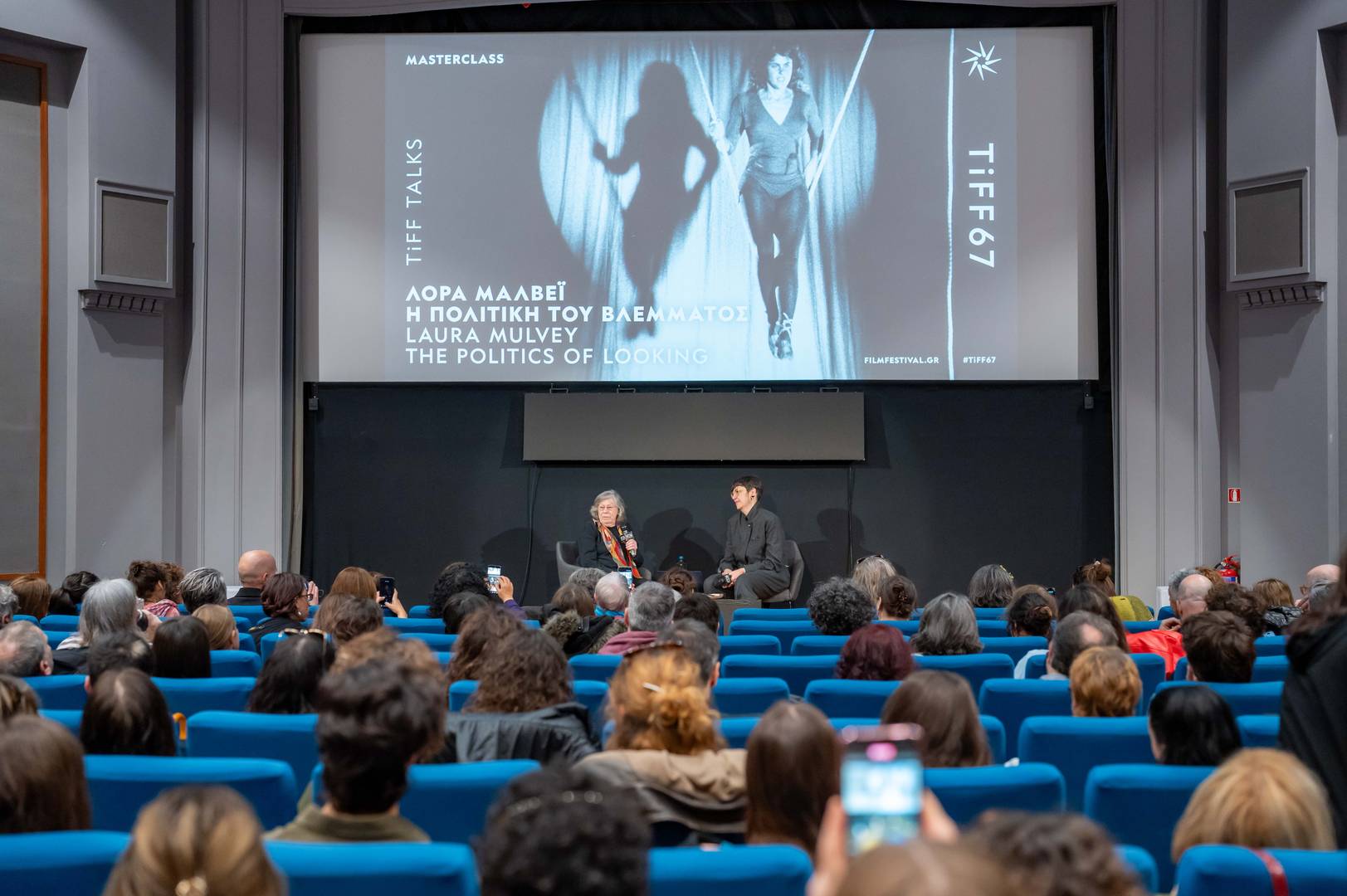
The prominent British filmmaker, author, theorist, and academic Laura Mulvey met with the audience of the 67th Thessaloniki International Film Festival for a fascinating discussion on Thursday, November 12th, at Pavlos Zannas theater.
Fifty-one years after the publication of her seminal essay Visual Pleasure and Narrative Cinema, Laura Mulvey, one of the most significant voices in feminist film theory, revisited issues of visual pleasure, desire, and spectatorship that have influenced generations of filmmakers, critics, and viewers. The discussion took place as part of a spotlight dedicated to Laura Mulvey, curated by the Thessaloniki International Film Festival and Georgia Korossi (BFI Digital Content Editor, independent curator & producer).
The event was moderated by Geli Mademli, film researcher and coordinator of the Festival’s publications, who welcomed Laura Mulvey to the packed Pavlos Zannas theater, emphasizing that this event stands out as one of the most remarkable discussions in the history of the Festival. “Judging by the huge turnout, no introductions are necessary. I would like to thank you on behalf of the Festival, as you are a source of inspiration. You bridge concepts that, at first glance, appear contradictory, and you manage to gracefully highlight the dialectic between them.”
The starting point of the masterclass was a journey back to the origins of the text that shaped film studies worldwide, with Laura Mulvey reflecting on the circumstances surrounding the creation of her 1975 essay. “I wrote this essay under the influence of the women’s liberation movement. In fact, we didn’t use the word 'feminism' back then; we spoke of 'women’s liberation. Moreover, it was not an academic text, given the fact that film studies, as an academic discipline, barely existed in the United Kingdom at the time. It was a rhetorical and political essay, and it is precisely in those terms that it should be read even today.”
Regarding the absence of a queer perspective in her original text, she clarified: “The queer liberation movement was, at that time, in its infant stages. In addition, as my text was a rhetorical, political essay, I focused on classic Hollywood cinema. In the Hollywood of that era, homosexuality was the absolute taboo. The emphasis placed on the woman as a spectacle was, to some extent, a result of this taboo: the desire to ensure that the male spectator would never come across himself on screen as an object of beauty. This erotic exchange was absent. Similarly, the essay touches upon neither gender fluidity, since I was analyzing a cinema that operated in strictly binary terms at the time, nor the rapid evolution of technology.
Referring to her later collection of essays, titled Afterimages: On Cinema, Women and Changing Times, Laura Mulvey commented on her choice to use the pronoun “he” for the spectator: “I was criticized for referring to the spectator as “he.” My choice, however, was entirely deliberate. I wanted to show that the aesthetics and language of Hollywood cinema were, in fact, addressed to the spectator as a man. Furthermore, in the language of that era, the pronoun “he” was used universally to denote the general subject. I was, therefore, interested in revealing how this linguistic generalization had been carried over intact into the language of cinema,” the theorist explained.
Continuing her retrospection, Laura Mulvey referred to Freudian psychoanalysis and the way it was transformed into a critical weapon against patriarchy. “In the early 1970s, within the context of the women’s liberation movement, we discovered Freud as an unexpectedly interesting source of critique against patriarchal society. We realized that psychoanalytic theory brought to light the vulnerabilities of patriarchy. It became obvious, for instance, that the dominant form of male sexuality confronts its own weaknesses, such as the fear of castration and fetishism. This was something truly fascinating for us.”
She also referred to the political significance of the absence of the first person in her writing, a dimension aptly highlighted by Geli Mademli, who pointed out that this specific choice transcends the narrow confines of academic writing, imbuing the text with the character of a timeless manifesto. “My decision not to use the first person was not accidental. I wanted to stress the political hue of the text and the fact that it expressed a collective line of thought rather than a personal stance. Writing in the first person had always been difficult for me, and relinquishing the “I” proved liberating,” she remarked.
Pertaining the contemporary aspects of her work, and the ways in which digital media and new technologies facilitate a fresh approach and critical analysis, Laura Mulvey invoked the French philosopher Jacques Rancière and his book The Emancipated Spectator. At the same time, she made a case for the dual nature of cinema, which functions both as a medium for storytelling and as a means of understanding time and temporality. “It is the only art form that plays with time and allows the spectator to do the same. In the past, we would sit in a dark room and watch a film. The viewer could not intervene in the timing or the meanings of the images. Today, however, things have changed with digital technology”, she explained.
Within the context of the open discussion, Laura Mulvey used the opening scenes of Alfred Hitchcock’s film Notorious as a prime example of how the mechanism of the “male gaze” is integrated into cinema. As she noted, the elements she critically analyzed in her 1975 essay had already been consciously incorporated by the director into his work as early as 1946.
The first image Hitchcock chooses is a motion-picture camera, that is the very instrument of viewing. He then links the camera to an exclusively male group of journalists, and subsequently to a man who is peeping voyeuristically through a partially open door. We may assume, therefore, that he is witnessing something shocking. Hitchcock, however, pulls the camera back, creating a strange sensation: the film tells us that nothing in this image holds any interest for us. We are watching a group of men in conversation; so uninteresting that they do not even merit a close-up. And then, an observer remarks: “Here she comes.” Suddenly, the image, which until that moment, was strictly male-dominated, shifts with the arrival of a female presence. The spectacle of beautiful femininity, the film’s star, appears. Hitchcock does not merely employ cinematic language to establish the male gaze; he goes as far as to introduce his leading lady at the same time as a “spectacle” and as the central narrative core of the film.
Analyzing the next scene, featuring the silhouette of Cary Grant and an illuminated Ingrid Bergman, the theorist explained: “This shot is interesting because Cary Grant’s dark silhouette is in the foreground, while Ingrid Bergman moves, illuminated, in the background, with the camera constantly following her. Cary Grant’s silhouette functions like the intrusive figure of a man sitting in front of us in a movie theater. In this way, Hitchcock brings the movie theater itself into the shot.”
Regarding the definition of the “male gaze,” Laura Mulvey added: “It is worth noting that in my original 1975 essay the term ‘male gaze’ appears only once, in the analysis of Josef von Sternberg’s film Morocco, where I point out that there is no dominant male gaze in that film.”
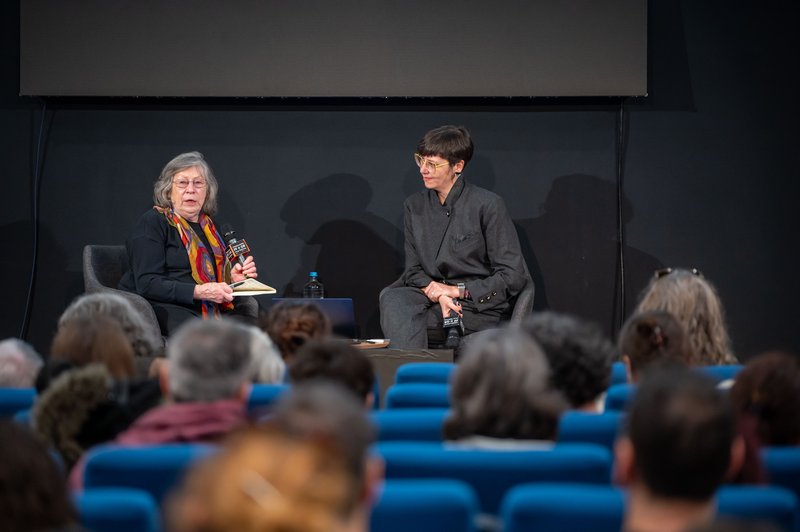
Regarding the distinction between pleasure and desire in cinema, Laura Mulvey explained how the digital age, in its turn, transforms the spectator. “With digital slowing down, the spectator is no longer identified as ‘he’, but rather as each one of us. It is all of us, with our manifold desires and our diverse ways of connecting with the image,” she noted, adding that, in this light, cinema is liberated and led toward a new kind of “cinephilia,” in which “play” and “curiosity” emerge as dominant structural elements in the reception of the narrative.
Curiosity, as we all know, plays a central role in the theorist’s work. “My second book of essays, titled Fetishism and Curiosity, deals precisely with this idea: how, for the fetishist, the female body constitutes a threat, and how, for that very reason, he has no desire to confront its truth. Sheila Rowbotham, an English socialist feminist and historian, used to say: “The woman question applies to the whole of the people.” And indeed, it is worth emphasizing here that, although feminism sought to carve out a space for the female voice, women’s rights have always been an issue that concerns society as a whole,” she said.
“While writing that essay, even more than the ‘male gaze’, it was the concept of ‘narrative drive’ that helped me grasp how Hollywood became masculinised. In classical cinema, because there was an enormous taboo against presenting men as beautiful objects to be looked at, the male character always had to be active, to dominate and to propel the narrative forward. Hollywood’s ‘narrative drive’ was always strictly masculine,” she highlighted.
With regard to Artificial Intelligence and whether “cinema dies with whenever a new technological invention comes up”, Laura Mulvey cited the work of theorist Jean Baudrillard from the early 1990s on the dialectic of time and repetition, as well as on how these two concepts are perceived differently in analogue and digital technologies. “Technology brings about an acceleration, but at the same time a social slowing-down also emerges, precisely as a result of the proliferation of economic, political and sexual exchanges. Baudrillard may be a harsh critic of technology, but in fact he offers us a way out of the inertia he describes, and in my view this contradiction is particularly ingenious.”
Replying to an audience question about the position of women directors in contemporary cinema, Laura Mulvey said: “In my latest collection of essays, I wrote about films directed by women for the first time. There have always been great pioneering women filmmakers and important works, such as Girls in Uniform and Meshes of the Afternoon. However, during the 1970s, for a brief period, films were made in which the feminist consciousness of their directors was clearly evident, including our own films, as well as those of Chantal Akerman, Sally Potter and others. Today, I believe that a new momentum has emerged: there are now enough women filmmakers for us no longer to speak of isolated exceptions. There is no single prescribed way of looking, nor is there a ‘unified female aesthetic’. There is, however, a way of thinking from a female perspective, through which we can approach and interpret stories that have so far remained untold and experiences that have yet to be represented.”
The film theorist also devoted particular attention to the concept of female curiosity. “Female curiosity has always been regarded by patriarchy as something transgressive, as in the case of Pandora opening the box, or women’s ‘gossip’,” she said, citing the novels of Agatha Christie, the most widely read female author in literary history, as an example of an alternative interpretation. “Here, curiosity becomes the tool through which the enigma is decoded,” she observed.
Asked whether curiosity could be commercialized through its fetishisation, Laura Mulvey drew an innovative connection between Marxist and Freudian theory: “In my book, I tried to connect Freud’s concept of fetishism with Marx’s commodity fetishism. In both cases, something must necessarily remain invisible for the mechanism to function. For Marx, capitalism must erase the visibility of human labour so that the commodity can appear dazzling and attract the consumer’s desire. If the consumer could see the traces of hard labour on the production line, the truth of capitalism would be revealed. Similarly, in Freud, the truth of the maternal body is concealed behind the fetishistic substitute,” she explained.
The restoration of Eva, a film by pioneering Greek director Maria Plyta, offered the occasion for another retrospection. The restoration was carried out by The Film Foundation World Cinema Project and the Cineteca di Bologna at the L’Immagine Ritrovata laboratory, in collaboration with Alatas Films and the Aristotle University of Thessaloniki Professor Betty Kaklamanidou, with the contribution of the Greek Film Archive and funding from the Hobson/Lucas Family Foundation. Laura Mulvey recalled the first attempt to organise a retrospective dedicated to women directors, in which she participated in 1972 (the Women’s Event at the Edinburgh Film Festival), noting how difficult it was at the time to gain access to films made by women
“That was when I first discovered that there had been a woman director working in Hollywood, Dorothy Arzner, whom I had never heard of until then. It turned out that the British Film Institute still held a print of Dance, Girl, Dance, probably dating back to its original release. They tracked it down, and so we were able to screen Dorothy Arzner’s work again, after several decades, this time from a feminist perspective. Similarly, although Meshes of the Afternoon (1943) had been known in New York since the 1950s, it remained virtually unknown in the United Kingdom,” she emphasised.
“What we have witnessed since then is the emergence of a feminist-oriented curatorial approach and systematic film programming, making a concerted effort to bring these films back into public discussion and circulation. Through this process, a much broader and more diverse cinematic landscape has come to light, one that had previously remained unseen,” Laura Mulvey added.
Asked to what extent her theories could be applied to today’s digital world, the theorist replied: “The ways in which young women continue to be subjected to violence, as well as the crisis surrounding their self-image, which selfie culture seems to perpetuate, are, in my view, among the most pressing issues of our time. I am not sure, however, that my theories, which are largely based on a binary understanding of gender, can help us fully comprehend this phenomenon. At the same time, it is difficult for someone of my age to grasp the true scale of the digital breakout. Certain aspects of it make me feel like a European peasant from the 14th or the 15th century who has just been introduced to the heliocentric theory claiming the Earth revolves around the Sun,” Laura Mulvey humorously concluded.



