
28th THESSALONIKI INTERNATIONAL DOCUMENTARY FESTIVAL
5 MARCH → 15 MARCH 2026

13.03.2026
NEWS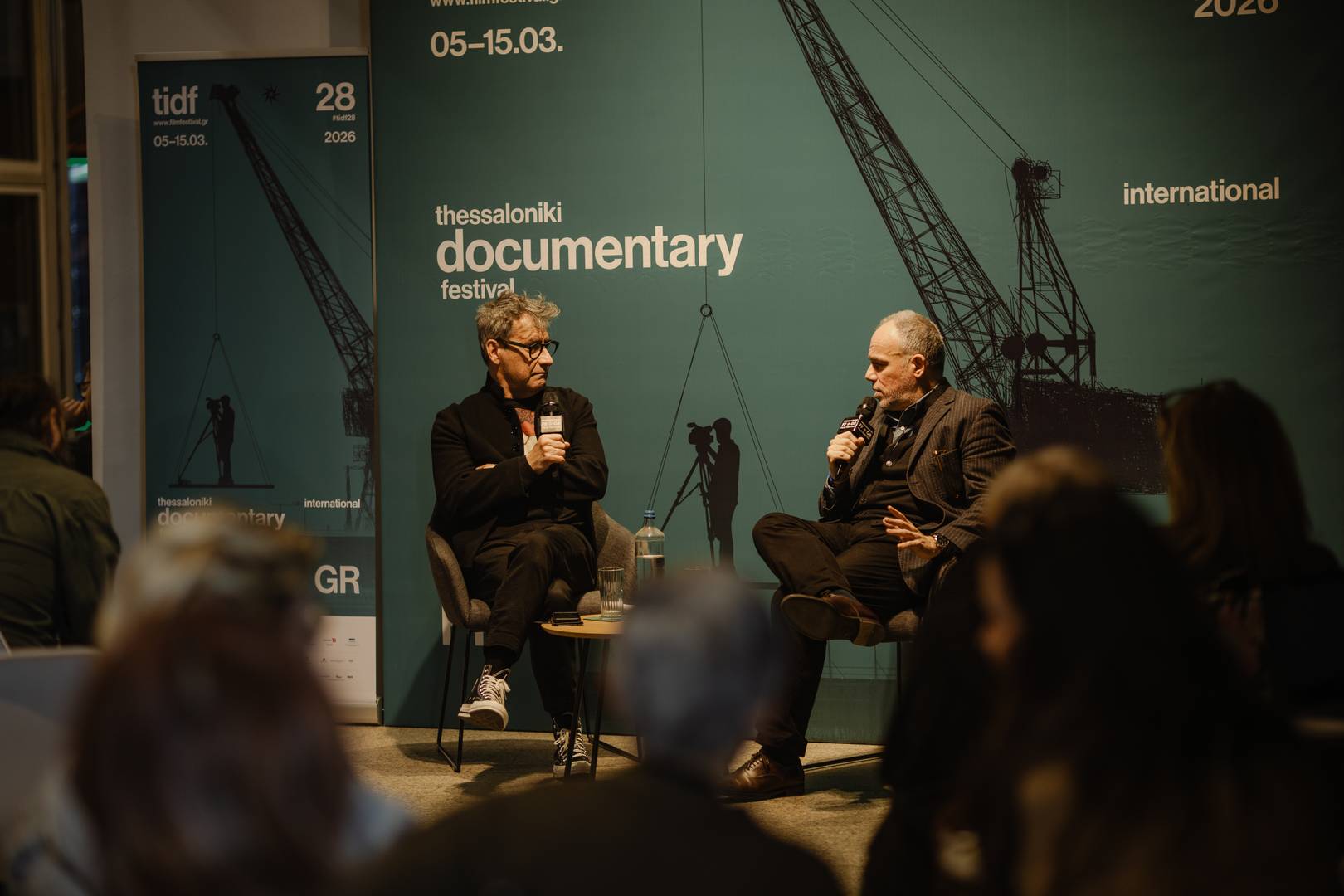
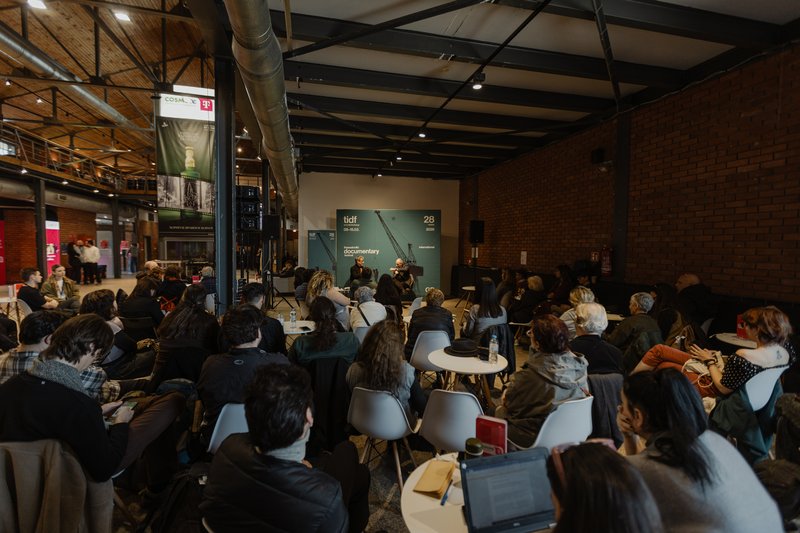
The power of the image as a historical record was the topic of an open discussion, titled “Photographs of the Kaisariani Execution and the Importance of Documenting the Historical Truth,” held within the framework of the 28th TiDF, on Thursday March 12th, at Warehouse C, featuring the historian and President of the General State Archives of Greece Dimitris P. Sotiropoulos as the main speaker.
The discussion, which converses with the 28th TiDF’s grand tribute to archives, focused on the role of documentation, the preservation of collective memory, and the historical circumstances that led to the events of May 1st, 1944.
The discussion was moderated by TFF’s Artistic Director, Orestis Andreadakis, who welcomed the audience, highlighting the importance of archives in safeguarding historical memory in an era when it is vulnerable to distortion and falsification. Historian Dimitris Sotiropoulos agreed, emphasizing the underlying tension between collective memory and historical documentation. “The distortion of memory is not a new issue. Historians tend to be wary of this concept, because it often undermines documented historiography.”
Regarding the historical context and the identity of the 200 victims at the Kaisariani execution, Mr. Sotiropoulos stressed that the documentation of their identities and biographies has been largely completed, with just a few minor discrepancies. “We know that the vast majority were members of the Communist Party of Greece, and that there were also fewer Trotskyists, as well as Archeiomarxists. We also know that approximately 20 people had been previously arrested at German checkpoints and were still being held at the Haidari concentration camp,” he noted. At the same time, he pointed out that the execution took place at a particularly critical juncture of World War II, following the Battle of Stalingrad and the beginning of the gradual retreat of the Nazi forces from the Eastern Front. “The execution of the 200 at Kaisariani was not only an act of retaliation for the assassination of Wehrmacht’s Major General Franz Krech by the Greek People's Liberation Army, but also a punishment for the communist circle itself, recognized as one of the Nazi regime’s principal adversaries.”

As for the photographer who captured the moments prior to the execution, Dimitris Sotiropoulos stated that, to date, information about his identity remains limited, and that the documentation process is still progressing. “As far as we know, he was a Wehrmacht Sergeant who fought in the first phase of World War II. He was injured in the face and discharged, before returning to duty in 1943, and being stationed in Greece, as part of a Sappers Unit in Malakasa.” As he explained, taking photographs was not an unusual practice for German soldiers at the time. “Many documented their presence in the occupied countries through photographs, often depicting everyday life within the framework of a peculiar form of ‘war tourism,’ which reflected the Nazi’s ideology about Greece and antiquity.”
Taking the floor, Orestis Andreadakis pointed out that photographs documenting atrocities in a direct manner are rare. “A characteristic example of such a photograph is the one depicting the Massacre of Kondomari, during the Battle of Crete. The entire execution is portrayed, from the round up of the villagers to the moment the shooting began,” the Artistic Director noted. Moreover, he raised the question of whether these photographs served propagandistic purposes or whether they were simply a means of recording for the Nazi regime, and Mr. Sotiropoulos explained that it was both.
Dimitris Sotiropoulos also focused on the importance of detached historical documentation and cautioned against the risk of memory being exploited for micropolitics’ agendas. “Sometimes, the average person can fall victim not only to historical circumstances, but also to ideology itself or to the mechanisms supporting it,” he observed, explaining that public discourse around such incidents tends to become controversial. “There is an aspect to historical documentation that must be approached with a spirit of detachment. Then, there is also what we call ‘Public History,’ which pertains to the disputes over collective memory. At times, there is the risk of reverting to approaches that were around during the Greek Civil War. This is wrong, no matter which side it stems from.”
Advocating for the truth is not solely the concern of historians. It concerns the relationship between democracy and truth itself, whether we’re referring to the present or the collective memory of the past - Dimitris Sotiropoulos
Concerning the acquisition of the photos by the General State Archives, Mr. Sotiropoulos expressed the opinion that the decision was pivotal for safeguarding collective memory. “The Greek State acted appropriately and efficiently. It purchased these photographs, ensuring their preservation within the collective memory, making them part of Greece’s legacy,” he stated, mentioning that photographs are an exceptionally important historical record, since they provide a clear account of the execution process for the first time. “We now possess photographs attesting to the massacre, exposing both the atrocities committed and the heroism of the people who were executed,” he said, adding that one of the images clarifies a crucial detail: “There was the impression that they were executed with crossfire from machine guns. Yet, the photograph shows a firing squad, which makes for an even more horrifying crime.”
Furthermore, he noted that documenting such historical events has greater significance these days. “Nowadays, fabricating false images or creating false memories is so much easier. That’s why the value of authentic archives remains paramount,” he stated, underscoring that safeguarding the historical truth is a crucial matter not only for scientific research, but also for democracy. “Advocating for the truth is not solely the concern of historians. It concerns the relationship between democracy and truth itself, whether we’re referring to the present or the collective memory of the past,” he concluded.




