
28th THESSALONIKI INTERNATIONAL DOCUMENTARY FESTIVAL
5 MARCH → 15 MARCH 2026

11.03.2026
NEWS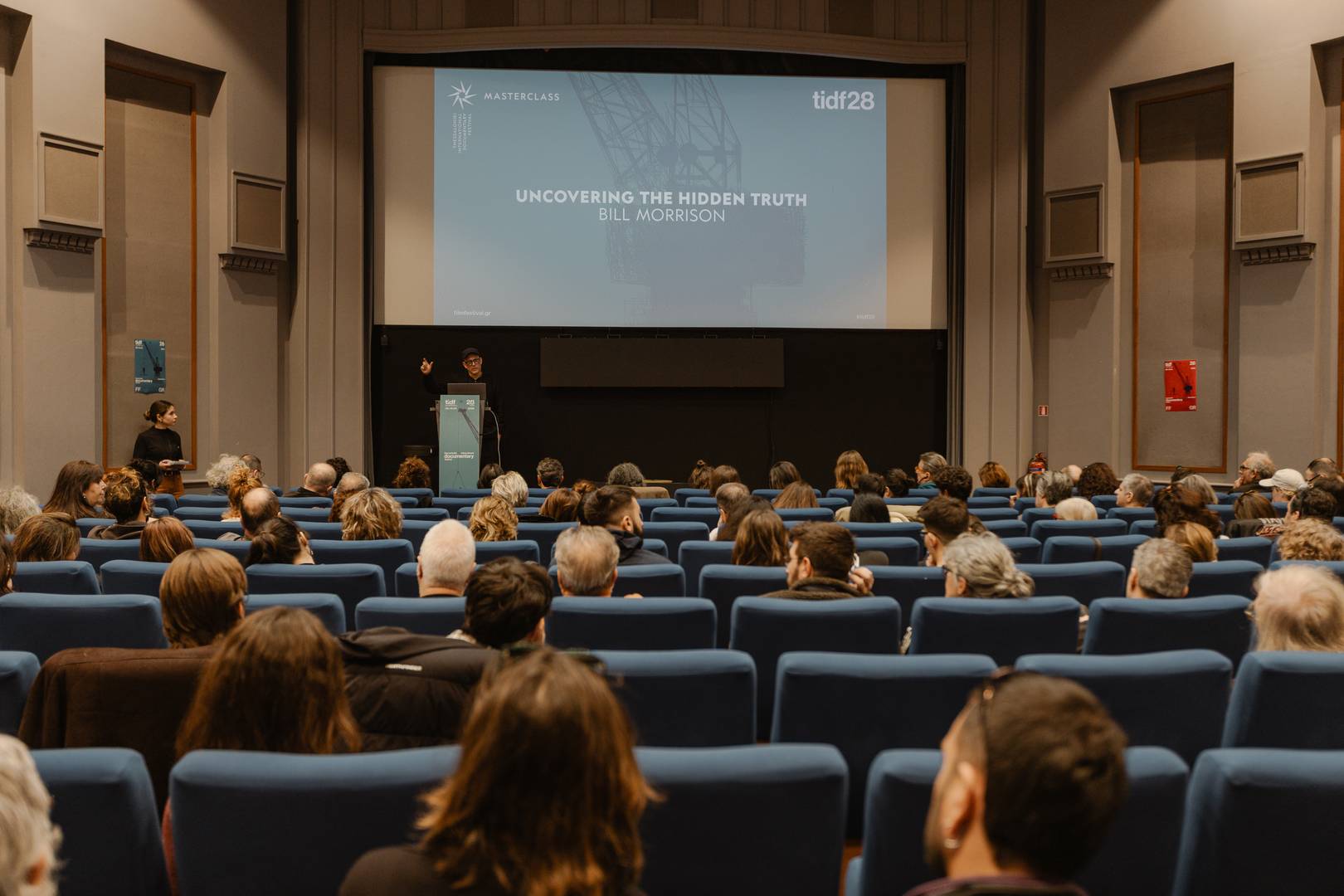
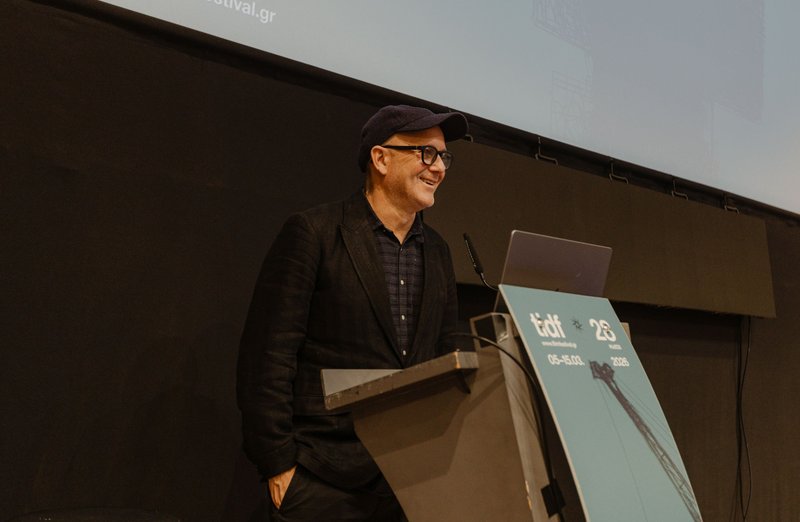
Audiences at the 28th Thessaloniki Documentary Festival had the opportunity to attend a special masterclass by the acclaimed American multimedia artist and filmmaker Bill Morrison, titled “Uncovering the Hidden Frame,” on Tuesday, March 10th, at the Pavlos Zannas theatre.
The masterclass converses with the Festival’s grand tribute to archives, while the 28th Thessaloniki Documentary Festival also hosts a spotlight on Bill Morrison, featuring six films by the groundbreaking filmmaker. During the session, Bill Morrison, heralded by the New York Times as the “poet laureate of lost films”, presented selected excerpts from his work, built around rare and partially damaged images. Drawing on a long and ongoing practice of uncovering and rescuing archives, Morrison’s work places particular emphasis on documentaries created from nitrate-based film.
“Thank you, I am truly delighted to be here. We’ve spent two wonderful days together in this theatre. In today’s masterclass I’d like to take the opportunity to show you some of my work that hasn’t been screened at the Festival. These are shorter films, and we’ll watch a few clips, around three or four minutes each,” Bill Morrison said at the opening of the masterclass, also referring to the people who inspired him to engage with films that revisit and reframe forgotten cinematic images.
“I started out as a painter, but eventually found my way to cinema, a dimensional art form, and I owe that to my professor Robert Breer at Cooper Union College, a distinguished animator, painter and photographer. His work fascinated me because he used photography to weave his imagination together with other sources of inspiration, constructing two parallel realities. Each frame felt like a different painting. He was also the one who introduced me to the work of the great experimental filmmaker Ken Jacobs, who in turn brought me into contact with the paper-print collection of the Library of Congress, an extraordinary archive of original films from the years 1896 to 1912, preserved in paper form.”
He went on to present clips from Robert Breer’s short film Fuji (1974) and Ken Jacobs’ Tom Tom the Piper’s Son (1969), alongside extracts from his own works Footprints (1992) and The Film of Her (1996). The latter foregrounds the decisive role of Howard Walls, a staff member at the Library of Congress, in saving thousands of film records from the previous century. The American artist also reflected on the effects of decomposition in nitrate film, showing how decay can endow the image with a new meaning, while giving the audience a glimpse of two nitrate-based films featuring a boxer and a Sufi dancer. He then spoke about the origins of the archival material and the path it follows before he eventually discovers it and brings it to the screen.
“Very often these are private collections that once lay forgotten in attics and basements before eventually finding their way into libraries, usually through descendants who inherited them and chose to donate them, allowing the material to reach a wider public,” he explained, showing photographs of himself during the search, recovery and processing of archival material. “It’s a remarkably rich body of archives, often without labels, that no one had ever really paid attention to, except me.” He added that in earlier years such material could not be reproduced visually. “In the past it was simply impossible. Today, however, extremely thin film can be digitised using modern scanners. That’s how a new chapter in my career began: I started visiting the Library of Congress regularly, trying to see what kind of film I could create from the material I had asked them to set aside.”
He also spoke about how images themselves become a source of inspiration in his work, presenting a clip from Who By Water (2007), which features portraits of steamship passengers he discovered in a research center. “I was intrigued by the dynamic of the portraits and by the way people behave while being photographed,” he noted. Bill Morrison also showed a clip from The Great Flood (2013), a film that captures a pivotal moment in American history through a collection of images paired with the distinctive soundtrack of musician Bill Frisell, with whom Morrison has collaborated since the 1990s. Their collaboration is also reflected in The Mesmerist (2012), which reconstructs, through editing and music, a nitrate print of the silent film The Bells (1926), which was also presented during the masterclass.
He then turned to films constructed around a single scene, such as Outerborough (2005), where archival footage shot in 1899 from the front of a trolley crossing the Brooklyn Bridge is presented into a split-screen composition. Another example is Release (2010), based on a scene filmed in 1930 that captures the crowd gathered outside a Philadelphia prison, waiting to witness the release of Al Capone. The sequence unfolds through repeated and mirrored archival images, capturing the restless anticipation of the people assembled outside the prison gates.
The multifaceted artist also presented clips from Light Is Calling (2004), where a luminous, dreamlike scene emerges from the reconstruction of a deteriorating black-and-white film, and Beyond Zero: 1914-1918 (2014), in which he processes authentic nitrate footage from the First World War that he discovered during a visit to the Library of Congress.
I believe I use this footage in an artistic way, trying to bring to the surface a broader, perhaps even metaphysical, notion of lost souls, of things that exist in the cracks. These are images no one has ever seen before. We see them only once, unless they are preserved. In that sense, films become, in a way, a metaphor for humanity.”
Questions from the audience also turned to Morrison’s creative process and the way he collaborates with musicians, particularly whether the music precedes the images or the other way around. “Every project unfolds differently,” he explained. “Usually, I give the composer a general idea and show some footage so the music can begin to take shape alongside the images. I want the musician to have the freedom to create on their own terms. Once the composition is complete, we move toward the technical structure and adapt the music to the image. In reality, it’s a process that develops in parallel.”
Asked about the way he processes archival material, Bill Morrison explained: “Until around 2010 it was very difficult to copy nitrate film. But after 2010 we had the opportunity to make high-definition scans, even from film that was already decomposing, and that meant we could actually preserve it.” Responding to a question about licensing archival documents, he noted that in the United States there is a specific legal framework for material older than 95 years. Such material is considered part of the public domain, meaning that no special permission is required for its use.
Addressing how he decides which archives to use and which to leave behind, Bill Morrison offered a revealing insight into his working method: “In a way it does become something like Schindler’s List. But if you try to save everything, the pressure becomes immense. So instead of going into the archive searching for something specific, I look for material that is on the verge of disappearing. The projects I make emerge from those images. It’s simply a different way of approaching research.”
Closing the masterclass, the 28th TiDF’s guest spoke about the visual dimension of his work: “I believe I use this footage in an artistic way, trying to bring to the surface a broader, perhaps even metaphysical, notion of lost souls, of things that exist in the cracks. These are images no one has ever seen before. We see them only once, unless they are preserved. In that sense, films become, in a way, a metaphor for humanity.”




