
28th THESSALONIKI INTERNATIONAL DOCUMENTARY FESTIVAL
5 MARCH → 15 MARCH 2026

10.03.2026
NEWS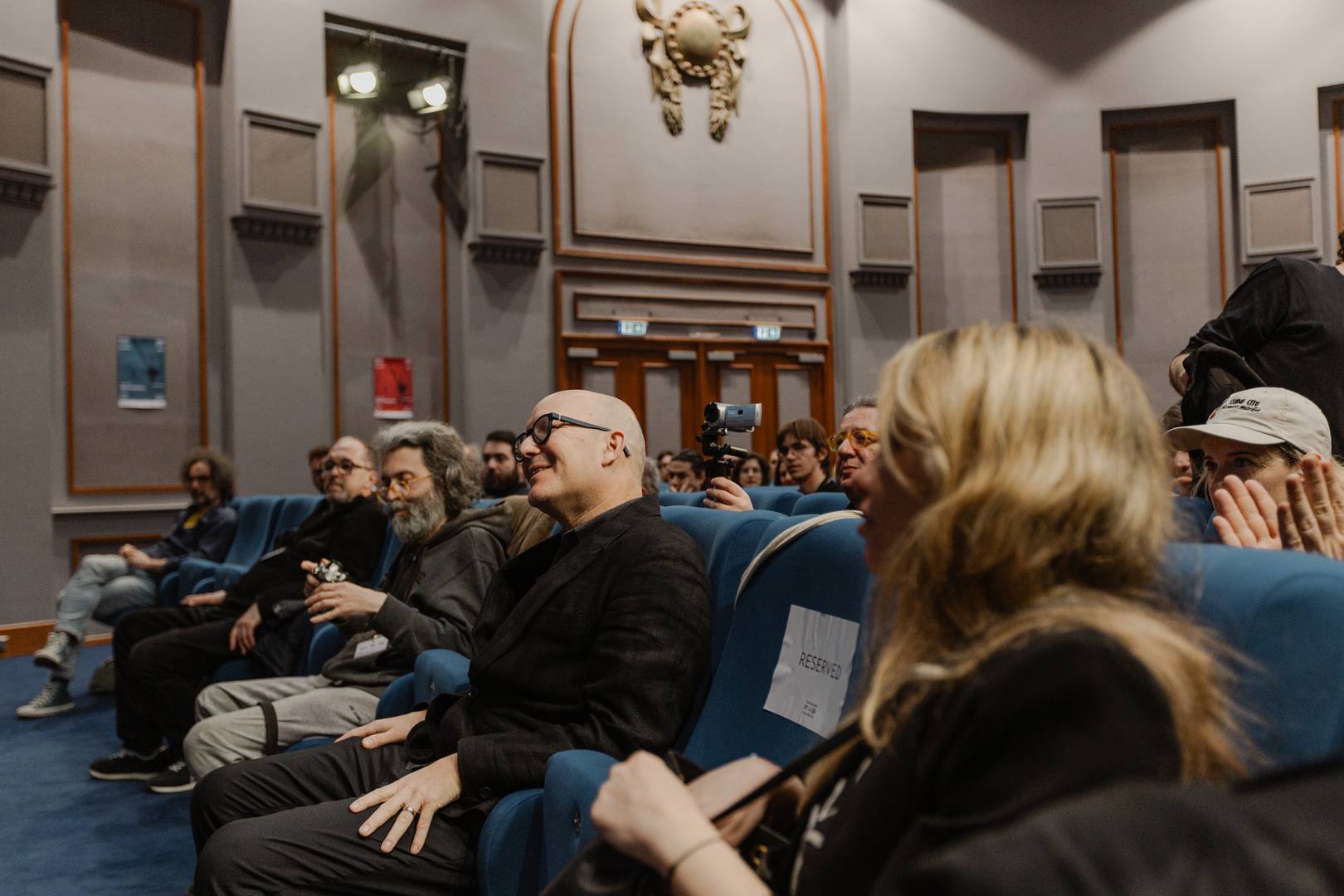
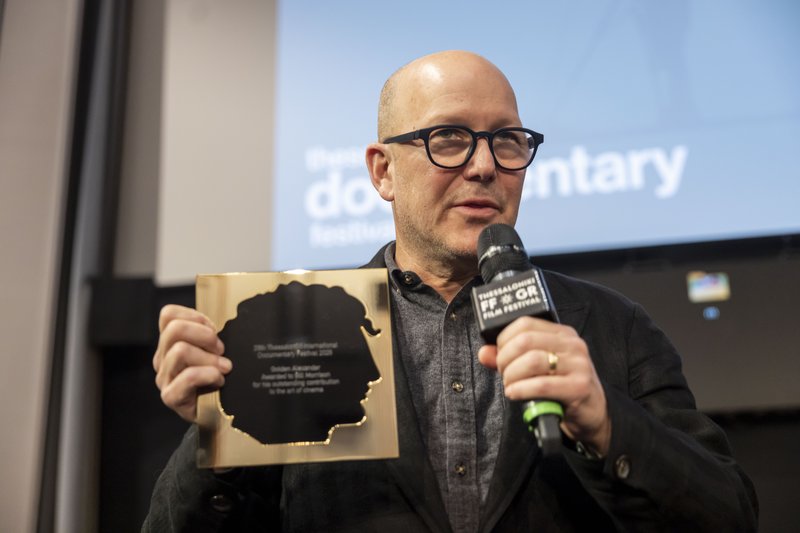
The 28th TiDF bestowed the Honorary Golden Alexander to the American multimedia artist Bill Morrison for his overall contribution to the art of cinema on Monday March 9th, at Pavlos Zannas theater.
The ceremony was followed by the screening of the film, Decasia (2002), the first film of the 21st century to win a place in the Library of Congress, having been deemed by the National Film Registry as a “flagship example of American cinematic heritage.” Bill Morrison, heralded by the New York Times as the “poet laureate of lost films,” transforms the film’s distortions into a commentary on the fleeting nature of images, comparing them to memories, ghosts or ciphers.
The prominent artist was given the Honorary Golden Alexander amidst a particularly warm atmosphere by TFF’s Artistic Director, Orestis Andreadakis, who welcomed the audience. “Ladies and gentlemen, this evening we are honoring the exceptional body of work of Bill Morrison, an artist who unveils the hidden life of cinema itself. Through the unique way with which he approaches film archives and the fragile nature of film, Morrison transforms decay into beauty, bringing to light forgotten stories which are etched onto the memory of the images themselves,” he initially remarked. “This year, TFF pays homage to archival cinema, Bill Morrison’s work is a powerful reminder of the creative and historical life preserved in the archives,” he added.
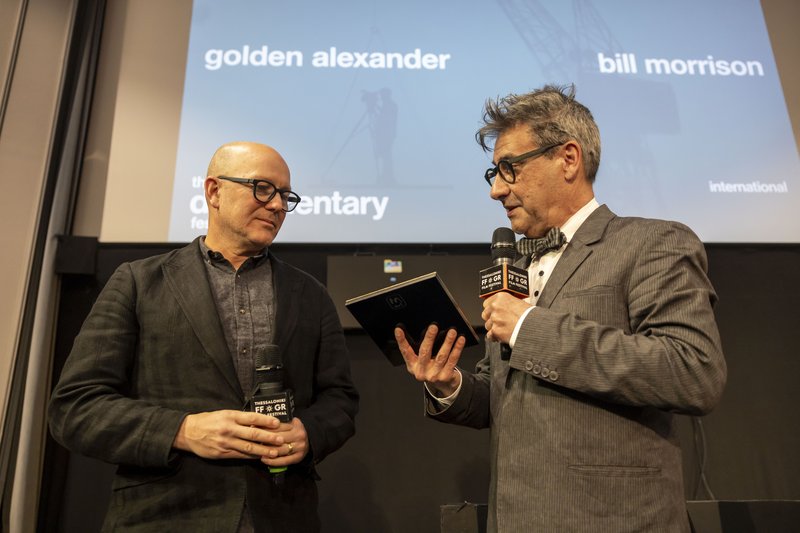
Bill Morrison received the award and thanked TFF for the immaculate hospitality and the tribute’s organization. “It’s a great honor for me - especially since it is the first time I’m visiting Greece and the city of Thessaloniki. Even though TFF has screened two of my films in the past - Dawson City: Frozen Time (2016) and Decasia (2002) - I haven’t had the opportunity to come until now. I‘ve enjoyed the first 24 hours in your city immensely, and I look forward to enjoying the following days and meeting different people,” he noted. In parallel, he expressed his enthusiasm about the tribute to his work, held within the framework of the 28th TiDF: “I will try to present as many of my short films as possible during tomorrow’s masterclass,” he added. This was followed by the screening of the film, Decasia, which unfolds as an evocative cinematic experience centered around the concept of time, loss, and the fragile life of images. After the screening, a discussion with the audience followed.
When asked about how his engagement with archival material began, and how the film’s concept came about, Bill Morrison said that the idea emerged through his exposure to previous works which used damaged film footage. As he mentioned, he wasn’t the first to employ this technique, referring to the characteristic example of Dutch filmmaker Peter Delpeut’s film Lyrical Nitrate from the 1990s. Bill Morrison was deeply impressed by the scenes in which the film had severely deteriorated. A few years later, when he found himself at the University of South Carolina for the first Orphan Film Symposium, he began exploring the Foundation’s archives, which contained a vast volume of damaged film footage. As he described, he found remarkably impressive excerpts from the get-go. It was then that he realized the damaged footage could form a film’s core language. At the same time, during that period of time, he was asked to create visual material for the composer Michael Gordon and a symphony which he hadn’t crafted just yet. Upon his return to New York, Morrison recommended an idea that would directly connect image with sound. Gordon creatively rose to the challenge, composing an “out-of-tune symphony,” a musical composition which, similarly to images, was shaped through a process of gradual deterioration.
Next, in response to a question regarding how music engages with the material and how it was processed during the editing, Bill Morrison explained that after returning to New York and presenting the idea of deterioration as the film’s core thematic axis, composer Micheal Gordon began experimenting with how musical instruments could be “disrupted.” The live presentation of his work in 2001 was particularly impressive. The orchestra was placed in a circular arrangement encircling the audience, whereas the screenings were projected onto scaffolding, supported by the musicians. “The audience sat on the floor and looked around. They were surrounded by musicians: it was a truly spectacular event,” Bill Morrison recalled. Referring to the film’s structure, the American artist noted that he was searching for a universal reconstruction of human experience. “What we all have in common is our shared past,” he expressed, stressing that early cinema constitutes a shared cultural memory from which contemporary cinema springs forth. That was the reason why he utilized footage from different genres of early films – ethnographic documentaries, travel films, newsreels, as well as fiction.
The film itself, he explained, is based on a poetic scheme of renewal. It is a work crafted from old films that “were sent to their deaths,” yet they resurface through a new creation. “It is as if they are retrieved from their ashes and transformed into a new film – a reincarnation of some kind,” he stressed, adding that the work is cyclical, thus embracing the cycle of life.
We don’t touch cinema. We use it to create the illusion of a space within which we are hoping to enter. - Bill Morrison
As for how his creative process was influenced by the direct connection with the film footage, Bill Morrison clarified that the digital scanning of the damaged footage permitted him to process them without risking further damage to the original material. As he mentioned, the direct connection with the film itself can alter the way a filmmaker approaches it: “When you have a direct connection with the footage, you are tempted to utilize it differently.”
Speaking about his experience, he underlined that usually the viewer doesn’t think about the materiality of cinema. “We don’t touch cinema. We use it to create the illusion of a space within which we are hoping to enter,” he expressed, describing cinema as a kind of “magical space” which conceals the technical process behind the image. His approach, however, was influenced by his background in painting and animation. Furthermore, he also explained that he was particularly interested in the physical qualities of the film and the idea that each frame could be perceived as a singular painting. “Each film can be considered a sequence of different painted images that quickly succeed one another,” he stated.
As he revealed, during his early steps he tried to create animated films or even deliberately distort various flawless films, so that each frame would be slightly different from the previous one. But once he realized that nature and time itself could cause damage to the material, he embraced the process. Concluding, Bill Morrison highlighted that the film makes you realize quite a lot about yourself as you watch it, emphasizing that the work turns its gaze towards the viewer, treating them as a conscious being who thinks and witnesses the viewing experience. In this way, the film doesn’t merely narrate images of the past, but it also activates awareness of the present.




