
28th THESSALONIKI INTERNATIONAL DOCUMENTARY FESTIVAL
5 MARCH → 15 MARCH 2026

14.03.2026
NEWS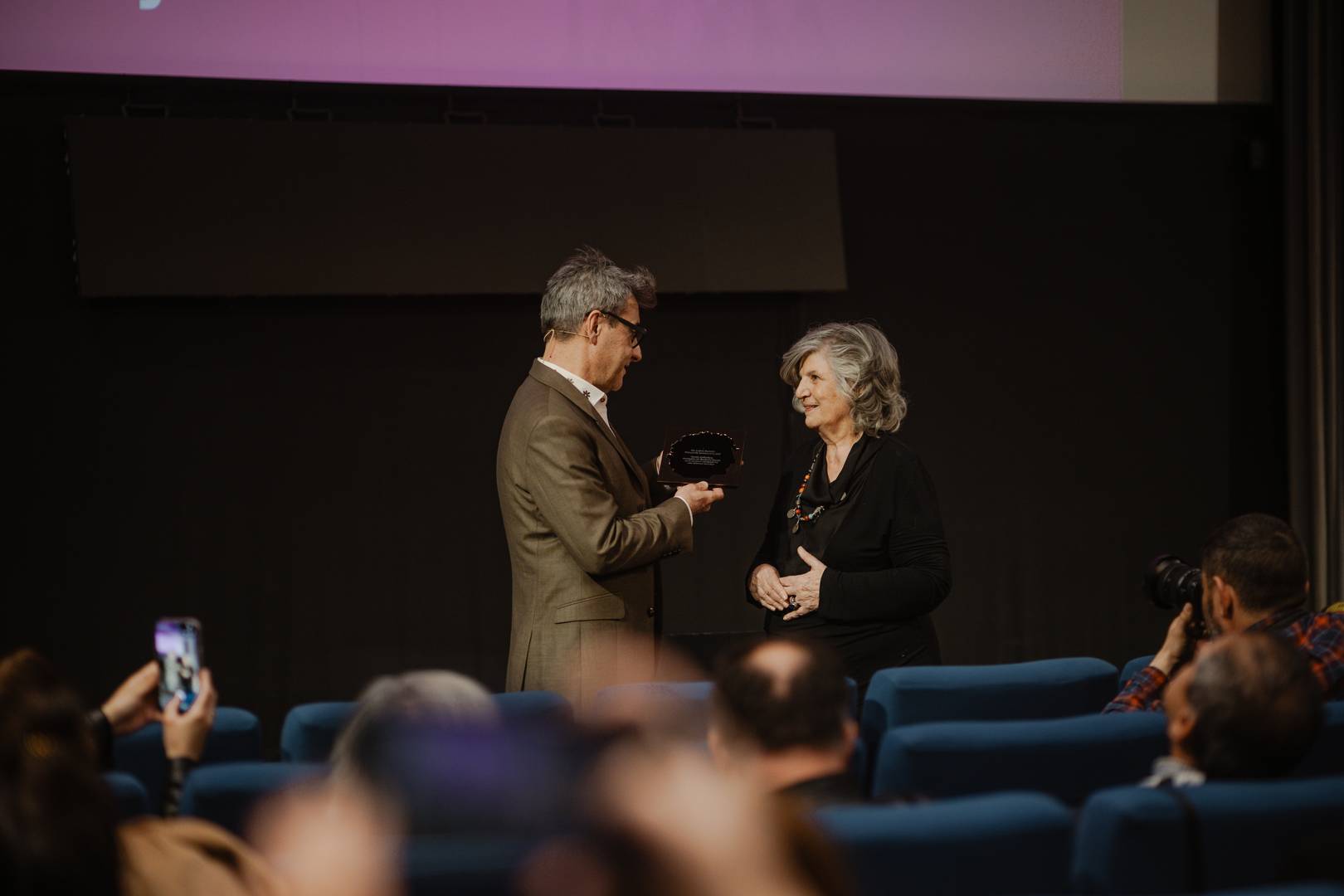
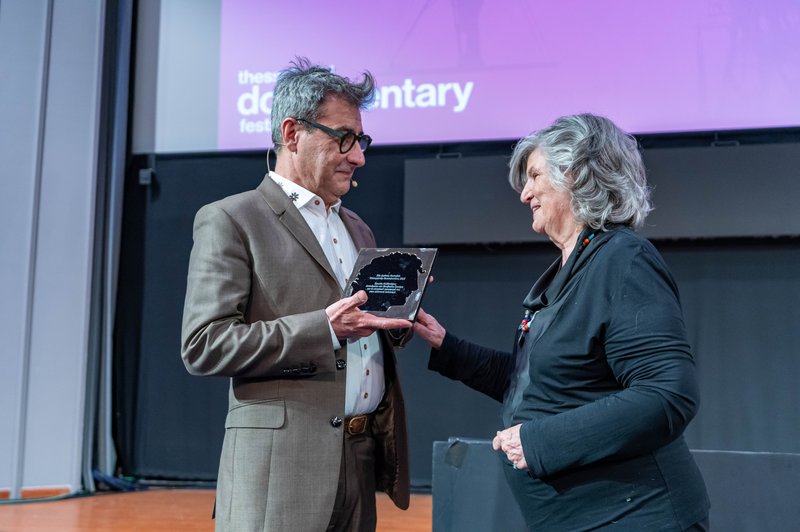
Within the framework of the 28th TiDF, the pioneering Greek filmmaker Vouvoula Skoura was honored with the Honorary Golden Alexander Award for her overall contribution to Greek culture, on Friday, March 13th.
The director accepted the award at a special ceremony, held at the Pavlos Zannas theater, where the audience had the opportunity to watch the short video installation Niki Marangou: Water Surfaces (2012), as well as Vouvoula Skoura’s most recent film, titled UTOPIA. The Poetics of Borders: Berlin – Nicosia (2025), in its debut screening.
The award was bestowed by TFF’s Artistic Director, Orestis Andreadakis, who spoke with great admiration about Vouvoula Skoura’s body of work and her invaluable contribution to cinema and culture: “Our time is a time of uncertainty: we live surrounded by constant noise, and this, unfortunately, also translates to cinema. And even amidst all this cacophony, there are still some creators who take a political stance – and I use this expression intentionally, because art is, first and foremost, a matter of the city, of the state, it’s inherently political –, who take a stance through silence, who know how to turn something inconsequential into something of significance, who manage to preserve the whisper, the nuance, and make it into the finest art. The woman we are honoring today, Vouvoula Skoura, is one of those. Dear Vouvoula, on behalf of the Festival, I present to you the Golden Alexander Award for your entire contribution to Greek culture.”
Upon accepting the award, Vouvoula Skoura expressed her heartfelt gratitude to TFF, as well as her intention to continue her artistic practice with the same dedication: “Thank you so very much, I’m deeply touched. This is the third award I receive from TFF. The first was given to me in 1984, the second in 2007, and now, with this award, we are coming full circle. But since I am an optimist, I say let’s start a third cycle, and perhaps even a fourth,” the filmmaker stated, eliciting applause from the audience. Immediately afterwards, the screening of the short video installation Niki Marangou: Water Surfaces took place, which was followed by Vouvoula Skoura’s most recent film, UTOPIA. The Poetics of Borders: Berlin – Nicosia (2025),
During the discussion with the audience, Vouvoula Skoura spoke about the two films that were screened and explained how the filmmaking process began: “The first part of Niki Marangou: Water Surfaces was shot with my own camera. We were thinking of making a film about Cyprus, together with Niki. But unfortunately, Niki passed away in a car accident. The years passed, and we decided to make a second film, the one you watched, UTOPIA. The Poetics of Borders: Berlin – Nicosia. Polina Tampakaki wrote one of the best film scripts I’ve read as of late, because it subverts the film’s narrative flow, in the same way I intervene in the picture. As you saw, I followed the first film’s script. Either way, I can not maintain a linear narrative structure. I don’t know how. Therefore, I make my films with a different approach.”
This is the third award I receive from TFF. The first was given to me in 1984, the second in 2007, and now, with this award, we are coming full circle. But since I am an optimist, I say let’s start a third cycle, and perhaps even a fourth. - Vouvoula Skoura
Regarding her travels to Cyprus and the filming experience in Famagusta, Vouvoula Skoura revealed: “I found myself in Cyprus for the first time in 1975, after the Turkish invasion. I had gone with the Greek Communist Party of the Interior and stayed at the house of the then General Secretary of the Progressive Party of Working People. That’s where I was able to collect extensive and astonishing photographic material from the archives at the offices of the Progressive Party of Working People. This was material carrying both emotional weight and historical significance. Next, I became involved with the Municipal and Regional Theatre of Cyprus, where, alongside friends, we made posters and went to the theater. The times I’ve been to Cyprus form, in a way, an uninterrupted trajectory. However, the trip with Niki was incredibly special, since we had numerous discussions - about Seferis’ work for instance - which are also portrayed in the film. Niki believed we should go to the occupied territories. She still had some old friends there and kept visiting them, holding onto this connection, as she thought it should be preserved.” As for her acquaintance with Polina Tampakaki, the scriptwriter of the film UTOPIA. The Poetics of Borders: Berlin – Nicosia (2025), the filmmaker noted: “I met her at a conference in Cyprus. She had engaged deeply with Niki Marangou’s work, and we agreed on many things. Tonight, you got to see the outcome.”
Subsequently, architect Kostis Mavrakakis, a collaborator of the Chania Film Festival and a friend of the filmmaker, took the floor to discuss his friendship with Vouvoula Skoura and the value of her work as an artist: “We’ve been close friends with Vouvoula Skoura since the ‘90s. I was familiar with her work and followed it with great interest, though I had never met her. We met through mutual friends, and our mutual love for cinema made us spend countless hours talking, from the very first moment we met, about films, directors, cinema and we’ve kept this up throughout all the years we’ve known each other. As soon as she finished a film, she would send it to me immediately, which sparked new, endless discussions. Among all the things I admire about her work is her ability to take on difficult topics, topics I’d have thought to be impossible to turn into a film,” he initially mentioned.
“It was as if she were making a personal wager, and when the time came for me to watch some of her films, I would end up repeating the following phrase: ‘I can’t believe how you were able to figure out what seemed to me like an impossible conundrum and create such a film.’ And yet, that’s how she crafted Inner Migration, Philoktetes – The Wound, Water on Table, and so many other films. Her cinematic language is purely visual. Through her films, she established a distinctly personal visual signature, an entirely personal vernacular,” he concluded. Vouvoula Skoura thanked him, adding that this is what it means to have good friends, to which the audience responded with a warm round of applause.




