
28th THESSALONIKI INTERNATIONAL DOCUMENTARY FESTIVAL
5 MARCH → 15 MARCH 2026

09.03.2026
NEWS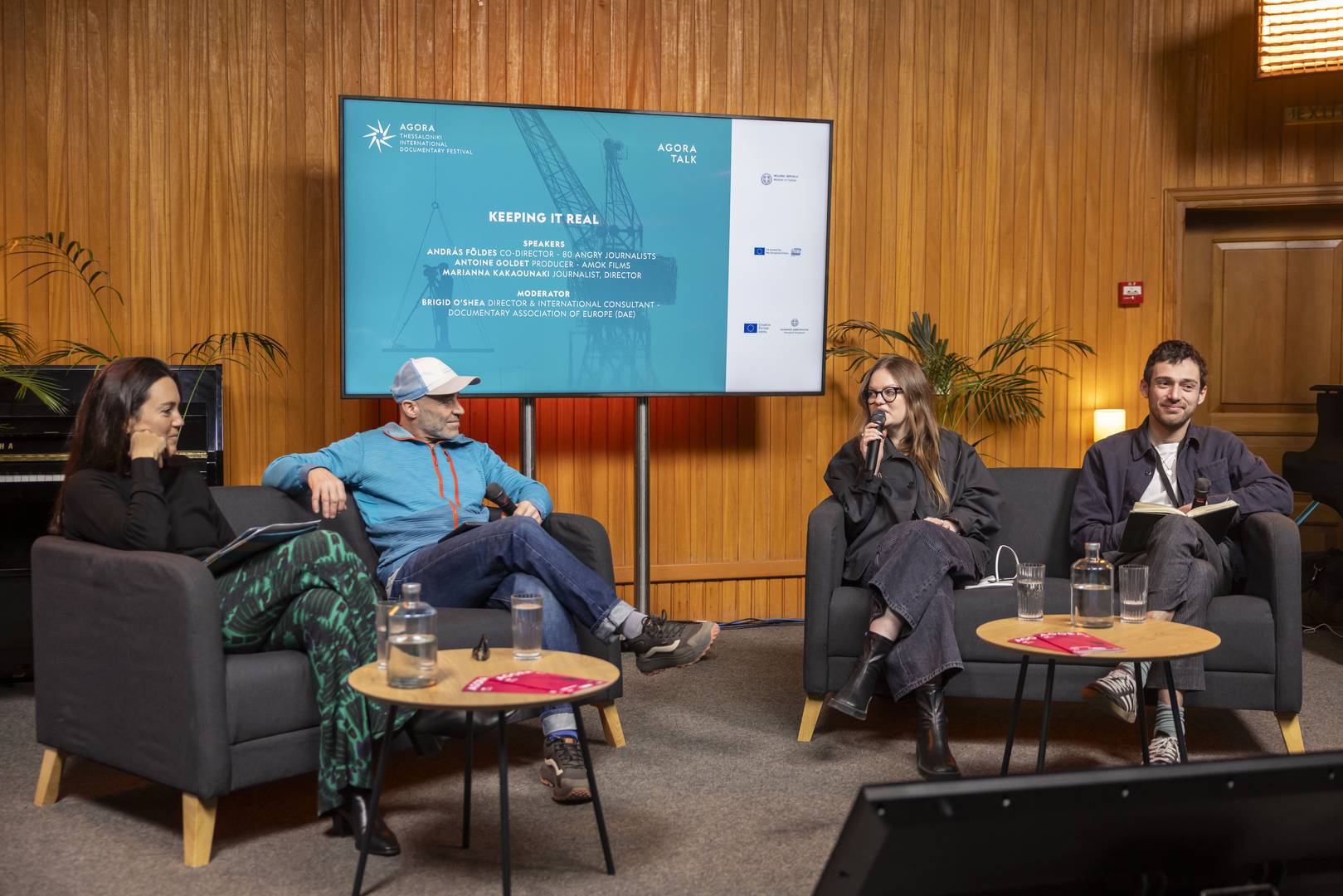
The discussion “Keeping it real” took place on Monday, March 9, as part of the Agora Talks at the 28th TiDF.
Opening the session, Thanos Stavropoulos, Agora Manager, warmly welcomed the audience and expressed gratitude to the Municipality of Thessaloniki for hosting the event at the Thessaloniki Music Center. He also stressed the importance of producing independent documentaries and introduced the panel, moderated by Brigid O’Shea Director & International Consultant - Documentary Association of Europe (DAE), which brought together András Földes (Co- director - 80 Angry Journalists), Antoine Goldet Producer - Amok films) and Marianna Kakaounaki (Director, Producer - Energeiaki Mesimvria).
The discussion focused on the role of independent documentary production in countering the erosion of press freedom, the spread of misinformation by numerous media outlets, and the systematic dismantling of fact-checking mechanisms.
Brigid O’Shea highlighted the personal, private, and political intersections of working as an investigative journalist while also using documentary filmmaking as a means of expression, and invited the panelists to introduce themselves. Marianna Kakaounaki described her path from journalism to documentary filmmaking, which began while she was covering a story in Turkey, noting that it offered her a different form of expression. Andras Foldes added that his own path was similar, explaining how he stepped into filmmaking and video reportage while covering stories about migrants. Antoine Goldet reflected on his journalism studies and professional experience in the United States, his return to Paris to work for a company producing investigative reports for French television, and his eventual decision to launch his own company focusing on investigative projects and documentaries.
The conversation then turned to the importance of journalism and documentary filmmaking, the challenges of financing such projects, the need to tell stories that matter, and the importance of giving journalists the time and space to develop their work, as well as the responsibility of fact-checking.
The session concluded with a discussion on artificial intelligence and whether it poses a threat to their work or could potentially replace them through AI tools. “I use AI in various ways, and it can be helpful, but I’ve never felt that the kind of work we do can be replaced. We put our souls into it, and a machine simply cannot do that”, Κakaounaki said. “Ι don’t feel threatened. It can assist people but it cannot really become a filmmaker” Goldet added. “The people who investigate and work in the field—this is something AI simply cannot replace”. Foldes noted.
The speakers concluded the discussion by engaging with the audience on the emotions that motivate their work and the importance of community and trust.




