FFGR


WASTE MANAGEMENT
We have already taken many steps towards reducing waste and diverting as much waste as possible from landfill, by working with experts and constantly learning how to optimize our waste management system.
MONITORING, REPORTING, BENEFITS
TIFF follows the fundamental principle of reducing waste production by preventing its creation (see Materials & Procurement), reusing and repairing materials, or even donating them to third parties when they can no longer serve the Festival's needs. Our aim is to rethink the way we manage resources and materials and to break free from daily habits that have become entrenched over the last few decades (e.g., the use of single-use plastics), including through the education/ awareness-raising of staff, partners, guests, and audiences.
At the same time, we are working systematically to reduce the amount of waste that ends up in landfills by increasing recycling or converting waste into energy, collaborating with experts and continuously improving our overall waste management system.
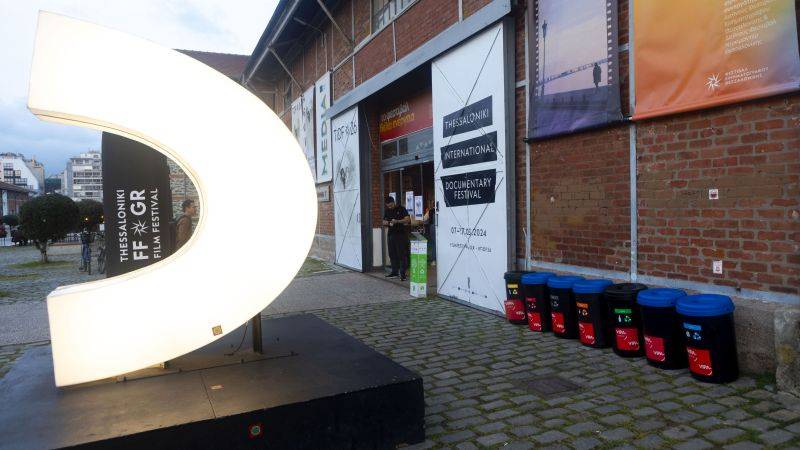
- During the Festivals/AGORAs, TFF collaborates with specialized companies to secure daily collection, sorting, and circular management of the waste generated. There are separate recycling bins, which are clearly marked and easily accessible, for the different waste streams, so that materials can be recycled, composted, or gain a second life. More specifically, since 2022 we have been collaborating with the following companies, from which we receive reports and certifications after each event’s conclusion, regarding the environmental benefits achieved:
- VIPA HELLAS S.A. The collaboration with VIPA covers both the preparation of carbon footprint reports for each Festival/AGORA (see Environmental Policy), and the collection and management of municipal waste generated across all Festival venues. Plastic, paper, glass, aluminum, organics, composites are collected in separate bins and sent for case-by-case recycling or for conversion into alternative fuel.
- Indicatively, based on the analyses that have been completed to date (up to the March 2024 Festival), the recycling of waste disposed of in VIPA bins (direct waste) prevented the release of 851.91kg CO2eq into the environment, whereas from March 2024 onwards, all direct waste is recycled or converted into energy, and none ends up in landfill.
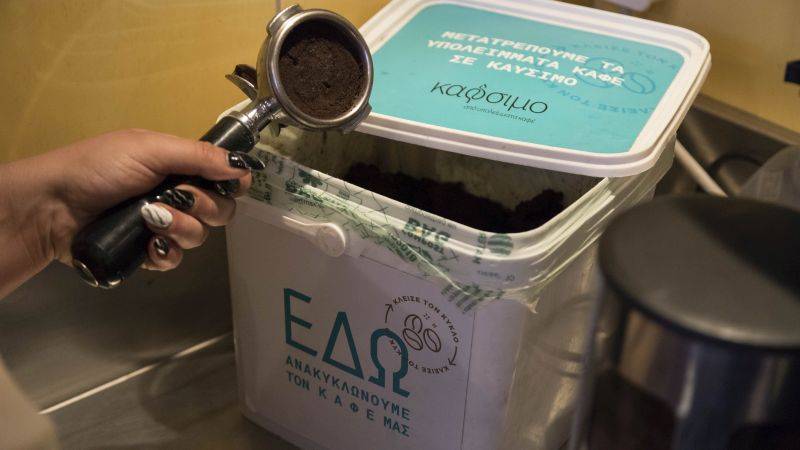
- InCommon (Innovative Communities Onwards, a civil non-profit company), for the collection and management of produced coffee waste from the 5 or 6 canteens of each Festival (coffee residues do not end up in the landfill, but are used for the production of bioenergy) and the produced food waste from the Agora lunches (composting).
- With regard to coffee waste management, a total of 747.26 kg of coffee has been collected and recycled since November 2022, preventing the release of approximately 3,362.75 kg of CO2eq into the atmosphere.
- With regard to food waste management, a total of 211.5 kg of organic waste has been composted, avoiding emissions of approximately 338.85 kg of CO2eq.
- Cigaret Cycle (a civil non-profit company), for the collection and management of cigarette butts (we have installed 18 bins for the collection of cigarette butts). Cigarette butts do not end up in the landfill or in the sea, but are turned into fertilizer or raw material of industrial plastic.
- Since 2022, a total of 243.9 kg of cigarette butts (418,200 cigarette butts) have been collected, from which 63.67 kg of fertilizer and 171.27 kg of raw material for industrial plastic have been produced. Based on relevant models, it is estimated that 1,027kg CO₂eq were not released into the environment.
- For waste management in Evia, we team up with Siakandaris Group and Cigaret Cycle.
- A "Merch drop-off" point operates at Warehouse C, Festival’s and Agora’s Centre in Thessaloniki, as well as in Kima, the hub of Evia Film Project, to promote reuse of information materials during the events.
- Throughout the year, for large quantities of paper, electrical and electronic materials, we collaborate with the waste management services of the Municipality of Thessaloniki, while for batteries we work with a specialized private company.
- As part of our efforts to reuse materials, we managed to repurpose a large number of old seats from the Olympion when, in the summer of 2024, we replaced the seating in the two Halls of the historic building (a total of 791 seats). The seats from the Pavlos Zannas Hall were donated free of charge to the Film Department of the Aristotle University of Thessaloniki. A number of seats from the Olympion were distributed to participants through a related crowdfunding program, while seats that were in relatively good condition were made available at a symbolic price to the city's residents, who responded with touching entusiasm to the initiative.
- Within the same context, the Festival is giving away computers that can no longer meet its needs free of charge to schools in the wider Thessaloniki area.