
FFGR

Screening of the documentary "Why the Mountains are Black: Rituals", in collaboration with TFF’s Grand Sponsor, COSMOTE TELEKOM
09.03.2026
NEWS
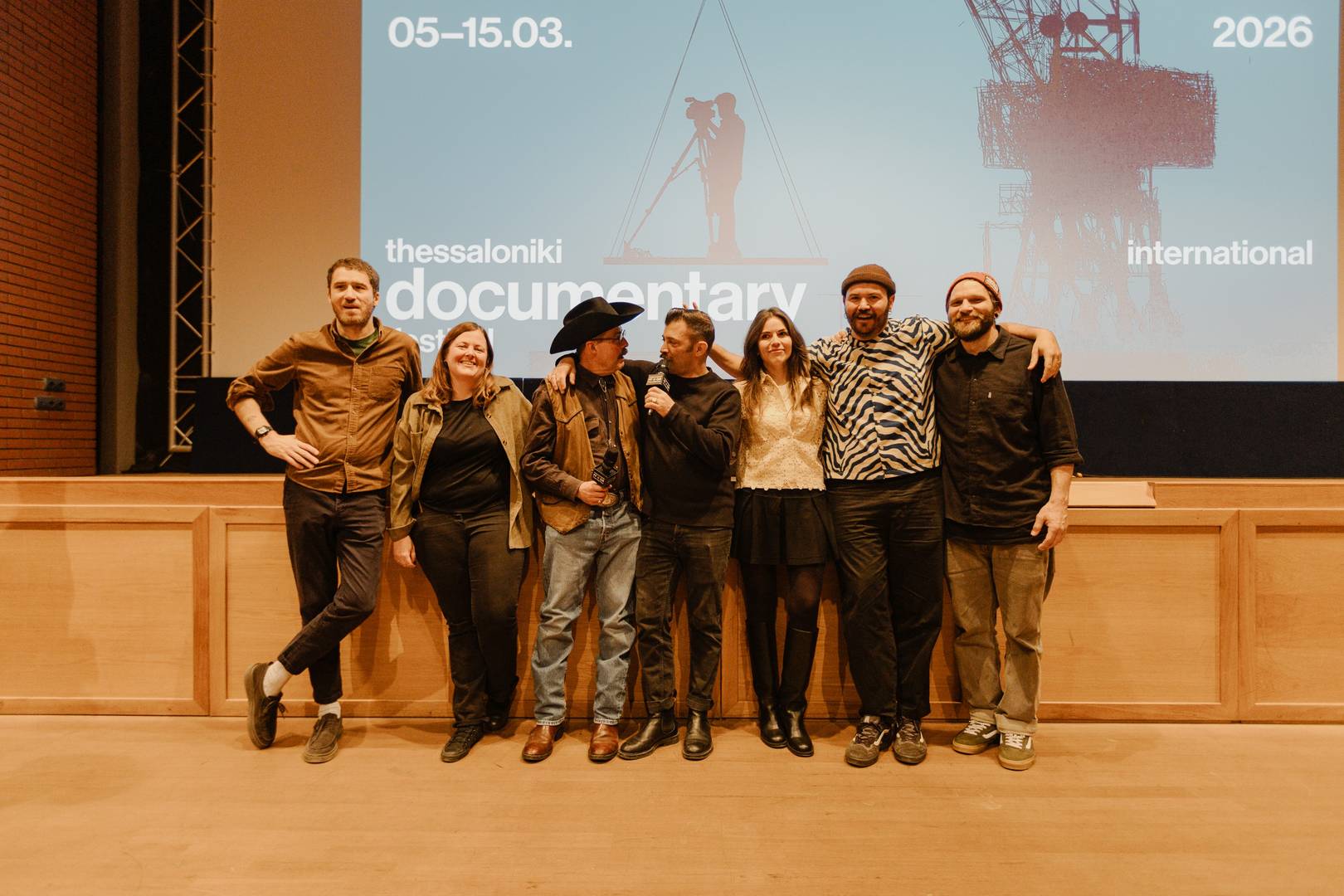
Within the framework of the 28th Thessaloniki International Documentary Festival, a special screening of the episode Why the Mountains are Black: Rituals, a co-production between COSMOTE TV and Onassis Culture, took place on Saturday, at the packed Tonia Marketaki theater, with the contributors in attendance.
The documentary series, directed by Fivos Kontogiannis, follows Christopher King, the Grammy-award-winning author of the book, “A Lament from Epirus,” as he travels across different parts of Greece. The series documents musical rituals, traditions, and lived experiences, exploring their deep connection to the customs of the life cycle and their significance as events of great importance for each community.
TFF’s Artistic Director, Orestis Andreadakis, welcomed the audience at the special screening: “I’m delighted to welcome you to the annual COSMOTE TV screening, which takes place every year at both TIFF in November and TiDF in March. We host the avant-premiere of a film, an episode, or a television series, such as the documentary series Why Are the Mountains Black, within the framework of which we are screening the episode Rituals here today. We’re also very pleased to continue our collaboration with COSMOTE TELEKOM.”
Faye Tsitsipi, Head of Content at COSMOTE TV, expressed her heartfelt gratitude to the Festival for the invitation and its hospitality, and then referred to the production team who brought this project to fruition: “Thank you all for being here, and of course, we would like to thank Mr. Andreadakis and the Festival for the invitation and their hospitality. We are here because we have a project that we are very happy about, a new six-part documentary series, co-produced by COSMOTE TV and Onassis Culture. I would like to thank all the collaborators who helped make this project a reality. Let me start with the team at COSMOTE TV and COSMOTE HISTORY, and all the colleagues who are based in Athens. I would also like to thank Christopher King, Katerina Kafetzi, Fivos Kontogiannis, Michalis Aristomenopoulos, and Loukas Valentis from White Room, and of course Onassis Culture, our co-producers, Afroditi Panagiotakou, Dimitris Theodoropoulos, and Vassilis Panagiotakopoulos. We all worked very hard to bring you a six-episode series, a journey into the music and traditions of Greece and the southern Balkans, captured through Christopher King’s gaze and camera lens. The series will premiere exclusively on COSMOTE HISTORY on Monday, April 13th, and it will also be available on demand on the platform.”
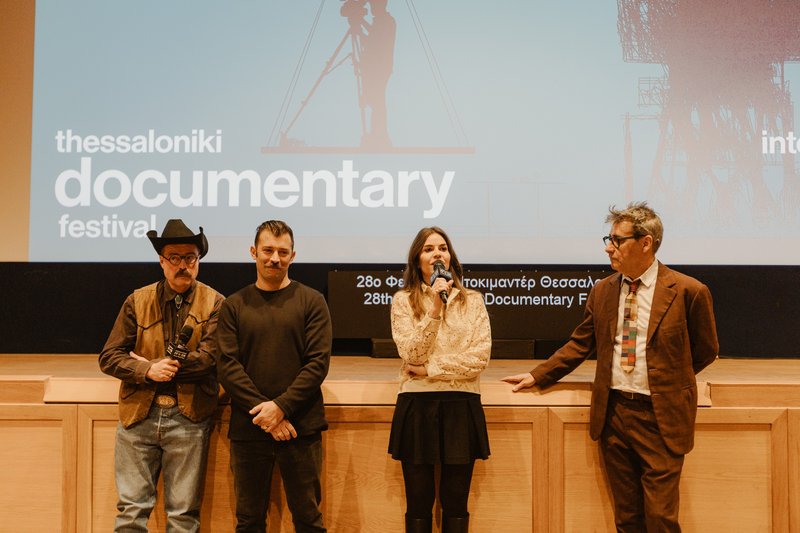
The director, Fivos Kontogiannis, invited the production team onto the stage, saying: “I wasn’t alone in creating this. Let me introduce you to Janine, who, alongside her work in editing and production management, also acted as our balancing force, to Michalis, our producer from White Room, who wasn’t merely a producer but so much more, supporting me creatively in everything, and to the Lambridis brothers, through whose gaze we will see what we are about to watch today.” In turn, the lead actor and host, Christopher King, remarked: “I’d like to welcome everyone here tonight. I am very grateful to have the opportunity to create for COSMOTE HISTORY, Onassis Culture, and my friends at White Room. I feel like I am part of a big family. Thank you for being here.”
During the discussion that followed the screening, Christopher King responded to a question regarding the origin of the title Why the Mountains are Black. “The series is a documentary, but at the same time it is also a mockumentary, as it contains fictional elements. This raises an underlying question: what is a cowboy doing in the mountains and why does he have the right to question music and identity?” he stated, providing a brief overview of the rest of the episodes in the documentary series.
“In the first episode, Air, we explore how musicians connect with musical instruments, and how these instruments themselves interact with air. Another episode, titled Steps, explores how the human body is connected to movement, through dance steps or otherwise. Another episode, titled Feathers, investigates how vanity can influence our culture. Another episode, Words, delves into the power of words, the way we say them, and how they ultimately impact the person who hears them. My personal favorite is Darkness, which revolves around why we believe mountains are black, memory, and what we choose to remember and what we choose to forget,” Cristopher King stressed.
When I first heard a lament, I thought I understood everything, yet as I kept listening to them and unearthing the wealth and depth of the tradition, I realized how little I knew. I constantly discover more. - Cristopher King
Then, Akis Sakellariou, President of the Festival's Board of Directors, spoke about the significance of this documentary and its contribution to documenting tradition: “We have seen other documentaries about rituals taking place across Greece, but the contemporary perspective, drawing on the language of cinema and the gaze of an outsider, offers a fresh perspective to what we consider tradition, and that is what matters most.”
Responding to a question about how the concept for the documentary came about, Christopher King disclosed: “That is a good question, because the answer starts with my life. From the moment I wake up in the morning, I’m surrounded by music tied to different cultures and peoples, ever evolving, which I long to explore and understand, as it is also connected to other Balkan countries. I could say that this fixation of mine began the moment I was born.”
When asked if there was any other place, apart from Epirus, that he loved just as much during filming, he revealed: “The more time I spend in this place, the more I learn about it, and the more I grow to love it. When I first heard a lament, I thought I understood everything, yet as I kept listening to them and unearthing the wealth and depth of the tradition, I realized how little I knew. I constantly discover more. One place with which I felt a profound connection and that touches me deeply is Crete, where I experience the same power of music that I feel in Epirus.”
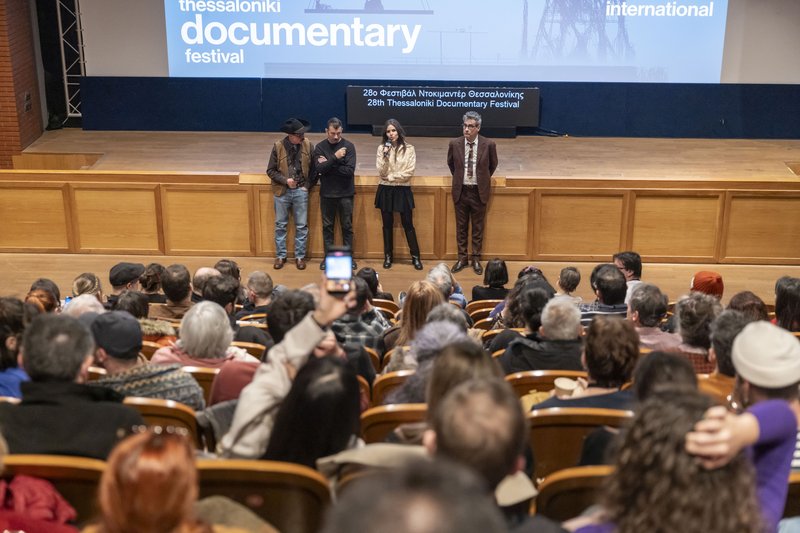
In response to a question about the filming and the participants’ reaction to the cameras, the director Fivos Kontogiannis noted: “I didn't get the sense that people were putting on a show in front of the camera. We tried to be as discreet as possible so that they could be their true selves. The documentary really takes shape during editing, so a lot of the work was done during filming, but a lot of it was also done afterwards, during the editing.”
As for the technical elements and the choice to use anamorphic lenses, the DoP Dimitris Lambridis added: “We got into some discussions with Fivos about how we'd cover this documentary series, so we had to keep in mind that we'd be holding cameras for hours on end for months, which is why we had to go with lightweight lenses. We wanted to capture Greece in a way that we haven't often seen before. So, we used anamorphic lenses, which, for those who don't know, are another type of lenses that capture the image differently, creating a new dimension. For the fictional part, we opted for a tighter format, shot on 16mm film, and used a tripod for static scenes, so that we could experience the fiction in a more cinematic way.”
After noting that the filming spanned six months, the director Fivos Kontogiannis wrapped up the discussion by reflecting on how we might come to know our traditions better: “My suggestion is that everyone should explore the customs of their place of origin, and then experience them firsthand. We shouldn't approach them as tourists. It's really important to reduce the commercial - touristic exploitation of customs and increase the authentic customs we still have. There are customs gradually disappearing because we no longer go to our villages.”



