
FFGR
Open discussion "Genealogy of the Future: Archive and Cinema"
10.03.2026
NEWS
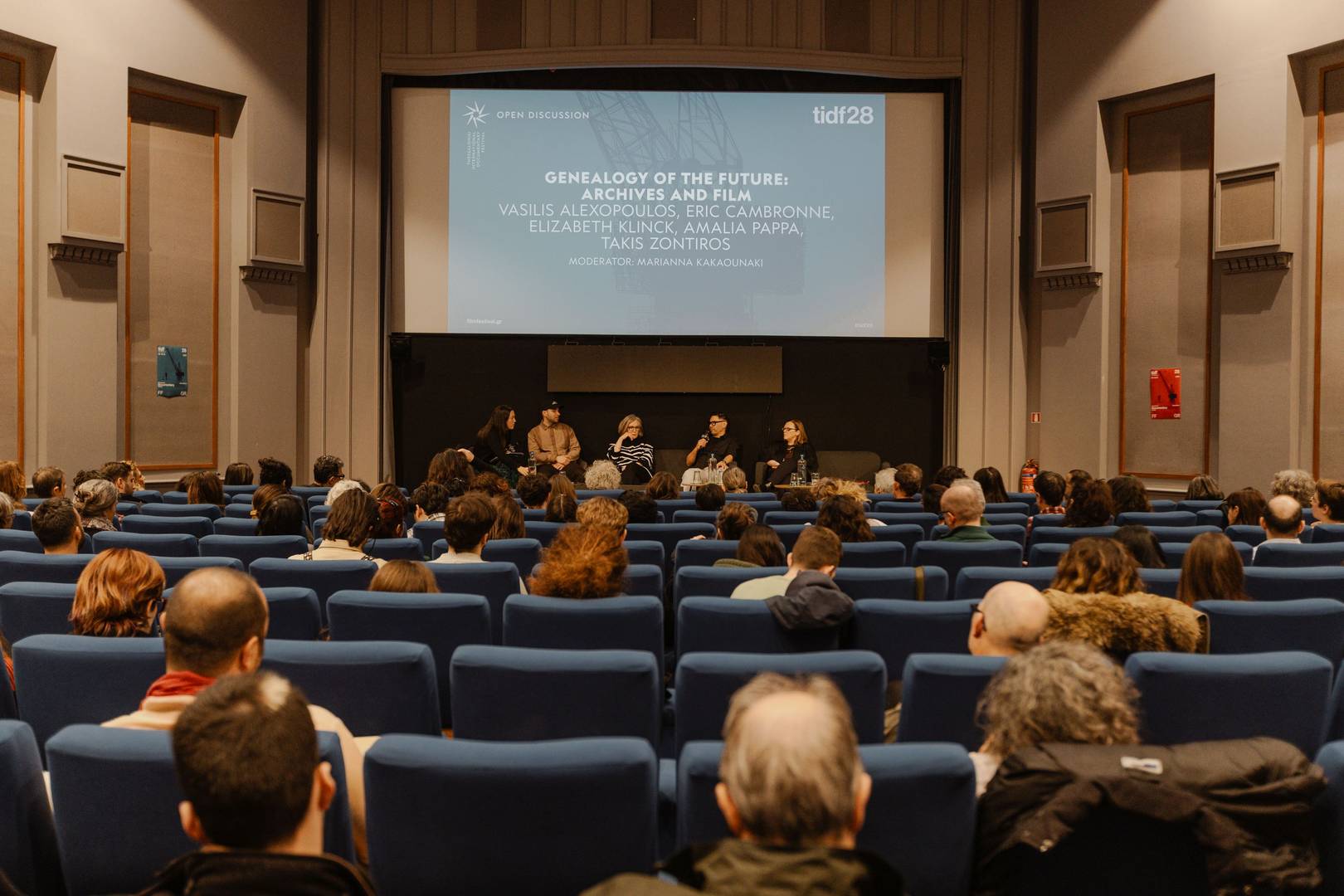
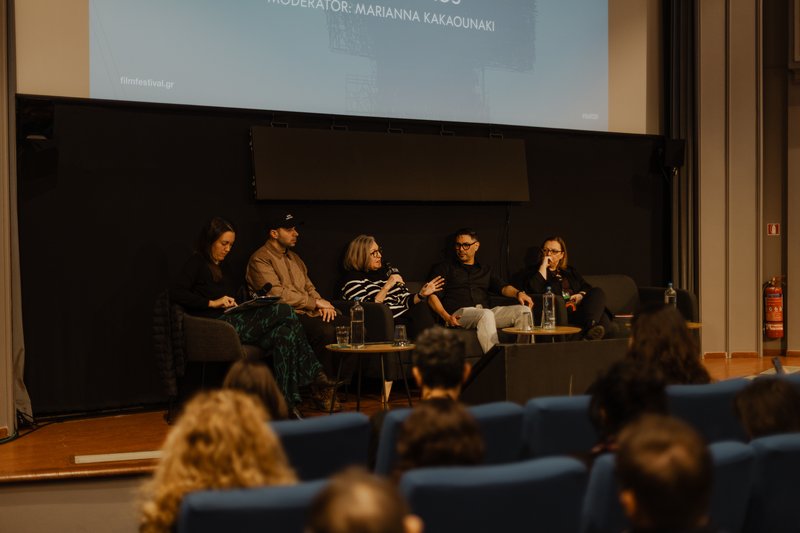
On Monday March 9th, within the framework of the grand tribute to archives presented by the 28th Thessaloniki Documentary Festival titled “All the World’s Memory,” an open discussion titled “Genealogy of the Future: Archive and Cinema” was held at Olympion theater.
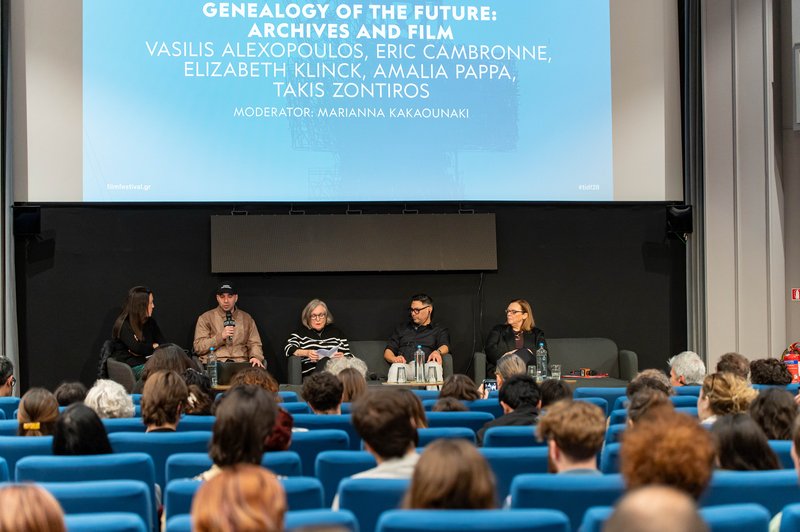
The panel brought together Elizabeth Klinck (producer, researcher and archival licensing specialist for hundreds of international documentaries), Amalia Pappa (Deputy General Director of the General State Archives of Greece), Éric Cambronne (Licensing Executive at British Pathé), and Takis Zontiros, also known as Greek Visions (instagrammer and curator of Greek cultural archives).
The discussion was moderated by journalist and filmmaker Marianna Kakaounaki. Shortly beforehand, the audience watched the short film The Unknowing of Things by Aristotelis Maragkos, one of the three parts of the archival film triptych Rewind, screened with free admission at the Takis Kanellopoulos theatre during the 28th Thessaloniki Documentary Festival. The discussion highlighted the many ways archival material can function: as a carrier of historical memory, an artistic tool, and a starting point for new forms of storytelling. Seen through this lens, the archive is not a static repository but a living organism, one that remains in dialogue with the present and sparks new ways of imagining the future.
The panel and the audience were welcomed and introduced by the Festival’s Artistic Director Orestis Andreadakis: “On the occasion of this year’s central tribute, we tried, through the films we selected, but also through conversations with filmmakers, to approach the concept of the archive from multiple perspectives, tracing the process of memory, its preservation and its transformation. At the very moment we were about to complete the preparation and structure of the tribute, one of the most striking archives of modern Greek history came to light: the photographs from the execution of the 200 WWII prisoners in Kaisariani.” Referring to the short film The Unknowing of Things by Aristotelis Maragkos, he added that “it is a film that will introduce you to the fascinating world of archives in general, and to the General State Archives of Greece in particular, with whom the Festival has collaborated for this year’s grand tribute.”
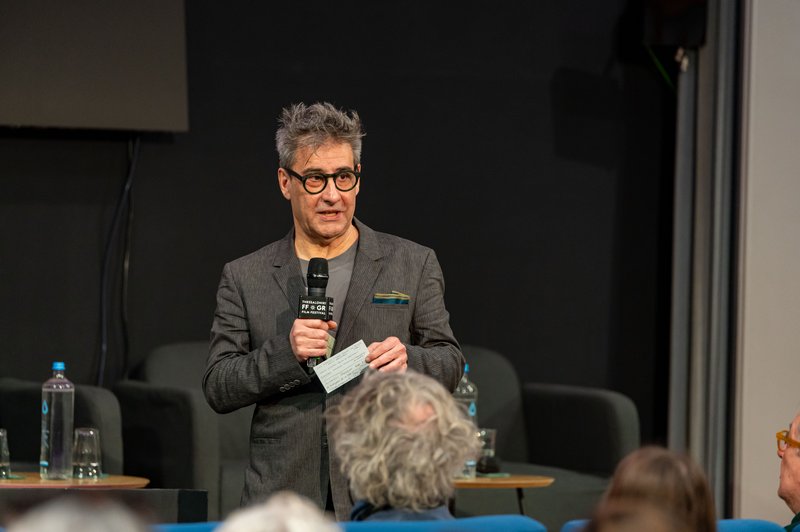
Before inviting the panel’s speakers to begin, Marianna Kakaounaki added: “The photographs of the 200 WWII prisoners executed in Kaisariani have brought renewed attention to this discussion. They have reopened the debate around questions of authenticity and ownership, while also showing that archives of this kind do not simply preserve history, but actively shape what we understand as collective memory.”
For her part, Elizabeth Klinck shared stories of archival discoveries that proved decisive in shaping the course of a project. “Sometimes, archives lead you to people of extraordinary interest,” she noted. “I was once working on an investigative documentary about the international trade of light arms. It was a Sunday, and I was browsing through related lists on YouTube when I came across a video posted by a pilot. I tried to track him down by following his digital traces. After some effort I managed to find him, and his involvement in the documentary ultimately gave the film a completely new perspective. It would not have been the same without him.”
Picking up the thread, Éric Cambronne spoke about the vast archives of British Pathé, noting that research can at times involve certain difficulties. “Sometimes, as you keep searching and searching, you can end up caught in a vicious circle,” he remarked. “An archive you were initially eager to explore may ultimately prove irrelevant to your subject, but the opposite can also happen.” He then referred to the British Pathé archives: “Our collection is extensive, as we hold around 85,000 films. The research method one follows each time is always relative and depends entirely on the project.”
Takis Zontiros, founder of Greek Visions, then took the floor: “I began by collecting material that I personally found compelling, but this passion soon grew into something much larger: an active community. My aim was to create an online platform, a living organism through which images from different decades and lesser-known corners of Greece could come to light. I was interested in giving space to photographs that did not portray Greek reality in a conventional way. Instead, I wanted to focus on the contemporary culture of each era.”
As the discussion unfolded, Amalia Pappa referred both to the often unseen work of the people behind the General State Archives of Greece (GSA) and to the restorative power archives can hold for those seeking a missing piece of their identity. “We are a living institution entrusted with the stewardship of memory. Very often, especially in Greece, the notion of the archive remains unclear. The associations people make tend to be limited to images such as basements, dust, or eccentric staff. Yet an archive is a space of communication and a gateway to the experience of the Other. What matters is not only the information an archive contains. The need for individuals to know their own history and to locate themselves within it is of profound importance, particularly today. Safeguarding both individual and collective memory is a non-negotiable priority. In Greece, however, the concept of the archive took time to take root at an institutional level. The General State Archives were founded only in 1914, on the initiative of Giannis Vlachogiannis, and since then they have managed to preserve a vast body of material from across the country, covering the earliest forms of political organisation in Greece through to the period of the Metapolitefsi,” Amalia Pappa noted.
“From the moment an archive enters the General State Archives, an invisible process begins, the work of archivists who undertake its restoration while also bringing to light the small stories of ordinary people whom history has often overlooked. The material then passes into the hands of conservators before eventually reaching the reading room. There, the encounter with researchers often takes on an almost therapeutic dimension. People sometimes arrive at our offices searching for a way back to their roots, descendants of refugee families who, through a kind of reverse journey, seek to recover fragments of their identity,” she explained.
Elizabeth Klinck also addressed the role of archives in preserving memory, referring to the documentary My Generation (2017), directed by David Batty and narrated by Michael Caine, stressing that whenever archival footage is used in a film, the material itself remains alive. “It’s a film about London in the 1960s, a time when a revolution was taking place, not only in music, but within the working class more broadly. What I loved about the documentary is that its visual layer relies entirely on footage from that period. You hear people speaking as they are today, yet visually the viewer remains entirely within that decade. There are many different ways in which archival material can be used creatively,” she noted.
At that point, Éric Cambronne added: “There is the example of Lebanese director Lana Daher, who, for her documentary Do You Love Me (2025), brought together a large body of archival material from the city of Beirut and used it as the structural foundation of the film’s narrative. Through a complex editing process, she constructed a story about the city and its communities, one that turns its gaze to trauma and war, yet remains both moving and at times unexpectedly humorous. At the same time, the use of such archives sends another important message: it helps keep the history of these peoples alive.”
Takis Zontiros then turned to the idea of nostalgia, speaking about the contrasts that archives can reveal in relation to how we imagine the future. “I launched the website in 2019 with a photograph of Iannis Xenakis. Many people say they are not interested in archives, and it’s true that we tend, almost instinctively, to talk about the future. Personally, I try to discover something new within the old. There is an entire dormant culture that can be activated through social media· stacks of magazines, for instance, which, if they are not brought to light, remain in a kind of historical limbo. What interests me most are the contrasts that emerge around the idea of the future: where we may have started, and where we eventually end up,” he noted, while showing the audience historical photographs from Greek reality.
The discussion also touched on the case of Belgian collector Tim de Craene and the photographs from the execution of the 200 WWII prisoners in Kaisariani. Addressing the issue, Amalia Pappa, Deputy General Director of the General State Archives of Greece (GSA), said she too had been deeply moved by the discovery. “This archive may belong to a private individual, but the information it carries is public and should become accessible to everyone. The Ministry of Culture reacted swiftly, and we have already conveyed our willingness, as the competent institution, to ensure that these archives remain accessible to all. The most important thing is that they were preserved and are back in Greece. At this stage, we are trying to determine whether they have a public character, as this would require a different form of handling. Owners of private archives often have a very close relationship with their material, and it can be difficult to persuade them that their archive should be entrusted to an institution. There has been a shift in recent years, but approaching such individuals still requires particular care. What is crucial is that whenever an archive is deposited with the GSA, the donor sets the terms of access, while the archive remains equally accessible to everyone and, of course, safeguarded for life.”
Looking to the future, the speakers of the panel agreed that Artificial Intelligence could become a powerful ally, while at the same time bringing questions of copyright and authenticity sharply to the forefront. Elizabeth Klinck emphasised that the human factor remains essential in every form of creation, artistic or otherwise. Éric Cambronne also raised the issue of harvesting, the automated process of collecting, aggregating and storing digital content or metadata. “In recent months, the UK government has placed harvesting firmly on the agenda following requests from major companies. This practice raises important licensing questions for people who own archives that are also accessible online. When it comes to Artificial Intelligence systems, no one can guarantee how the material provided to them will ultimately be incorporated.”



